
No Time to Read? How Busy Professionals Turn Dead Time into Learning Time
The reading pile is not a discipline failure — it's a format problem. Discover how busy professionals reclaim 90+ minutes of daily dead time and turn it into the professional development that actually keeps them ahead.
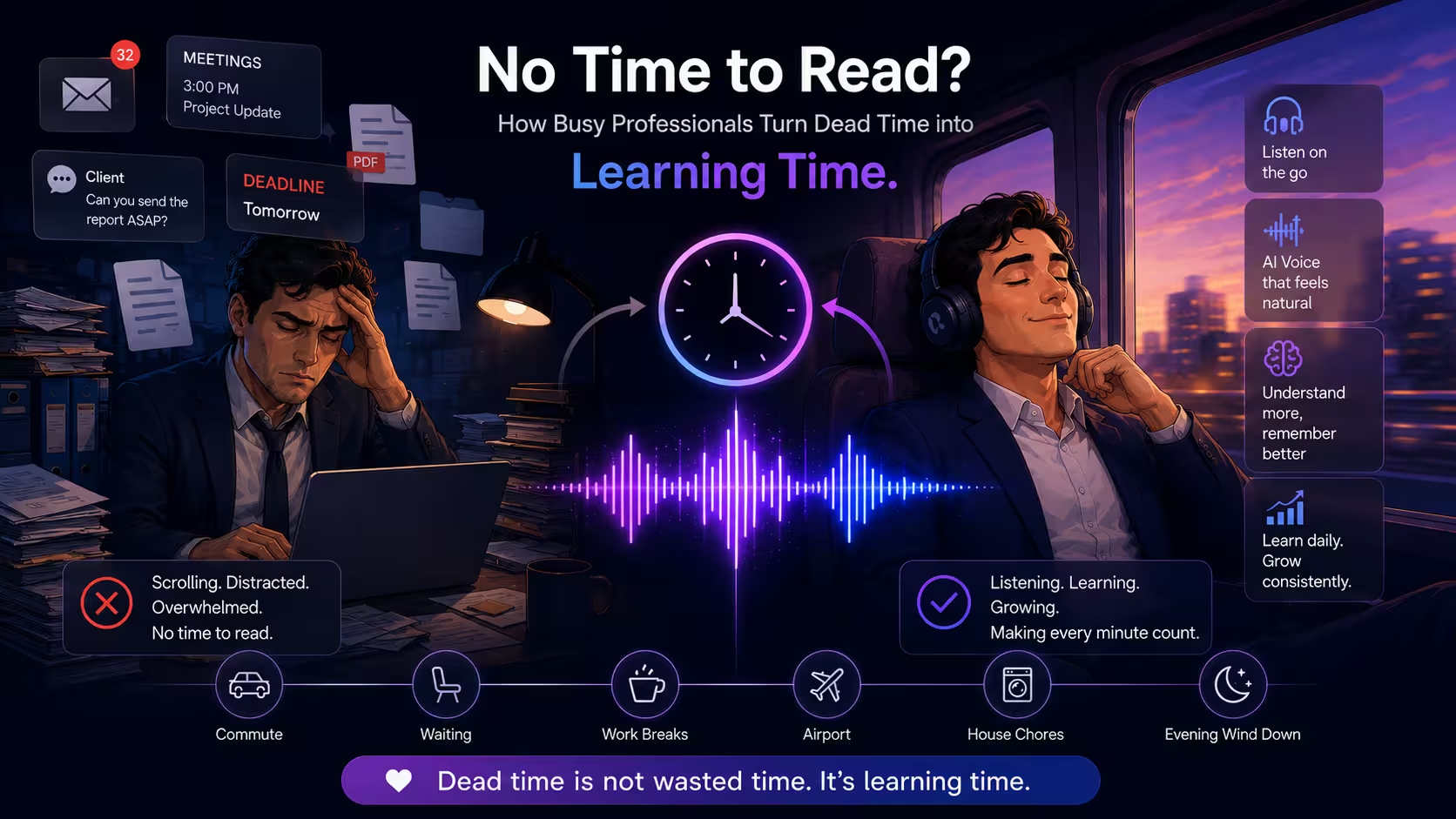
"The time was always there. It was just waiting for the right format."
There is a folder on your browser. Or a Pocket queue. Or a Substack digest. Or a pile of printed reports on the corner of your desk that gets shifted rather than read every time you clear space for a meeting.
You know the one.
It has articles your colleague forwarded with the note "worth a read." Industry reports you downloaded the morning they were published. Newsletter issues from writers whose thinking you genuinely value. A business book someone recommended three months ago that you bought immediately and have opened exactly once.
None of it has been read. All of it matters. And the stack keeps growing.
This is not a discipline problem. This is not a prioritization failure. This is the defining information experience of the modern professional: more worth reading than time to read it, with no realistic prospect of that ratio improving. What changes — what has to change — is not the size of the stack. It is the method.
The Real Cost of the Unread Pile
Let's be direct about what falls away when the reading does not happen.
It shows up in meetings — the moment someone references a market shift you would have known about if you had read that report. It shows up in client conversations — the question you cannot answer confidently because the industry landscape moved and you did not move with it. It shows up in your own thinking — the ideas that are not forming, the connections that are not being made, because the inputs have dried up.
Continuous learning is not a soft professional virtue. In most fields, it is the mechanism by which people stay relevant. The professional who reads widely, thinks carefully, and arrives at work informed has a systematic advantage over the one who does not — not because they are smarter, but because they are better supplied.
The problem is that "read more" cannot compete with the forty-hour week, the commute, the family, the exercise, the social obligations, and the basic human need for rest. Something has to give. And reading — which feels optional in a way that a meeting or a deadline does not — almost always gives first.
The Unread Pile
The guilt compounds each week. The knowledge gaps widen. Industry shifts happen and you are the last to know — not because you lack curiosity, but because the format demands time you simply do not have.
Audio with ReadLoudly
Every commute clears an item. Every run processes a newsletter. Audio does not ask you to carve out new time — it folds into the time you already spend doing other things, daily, without fail.
ReadLoudly tools: PDF Reader · Text to Speech · Notes to Audio
The Arithmetic of Recovered Time
Most professionals dramatically underestimate how much unoccupied audio time their day already contains. Work through it concretely.
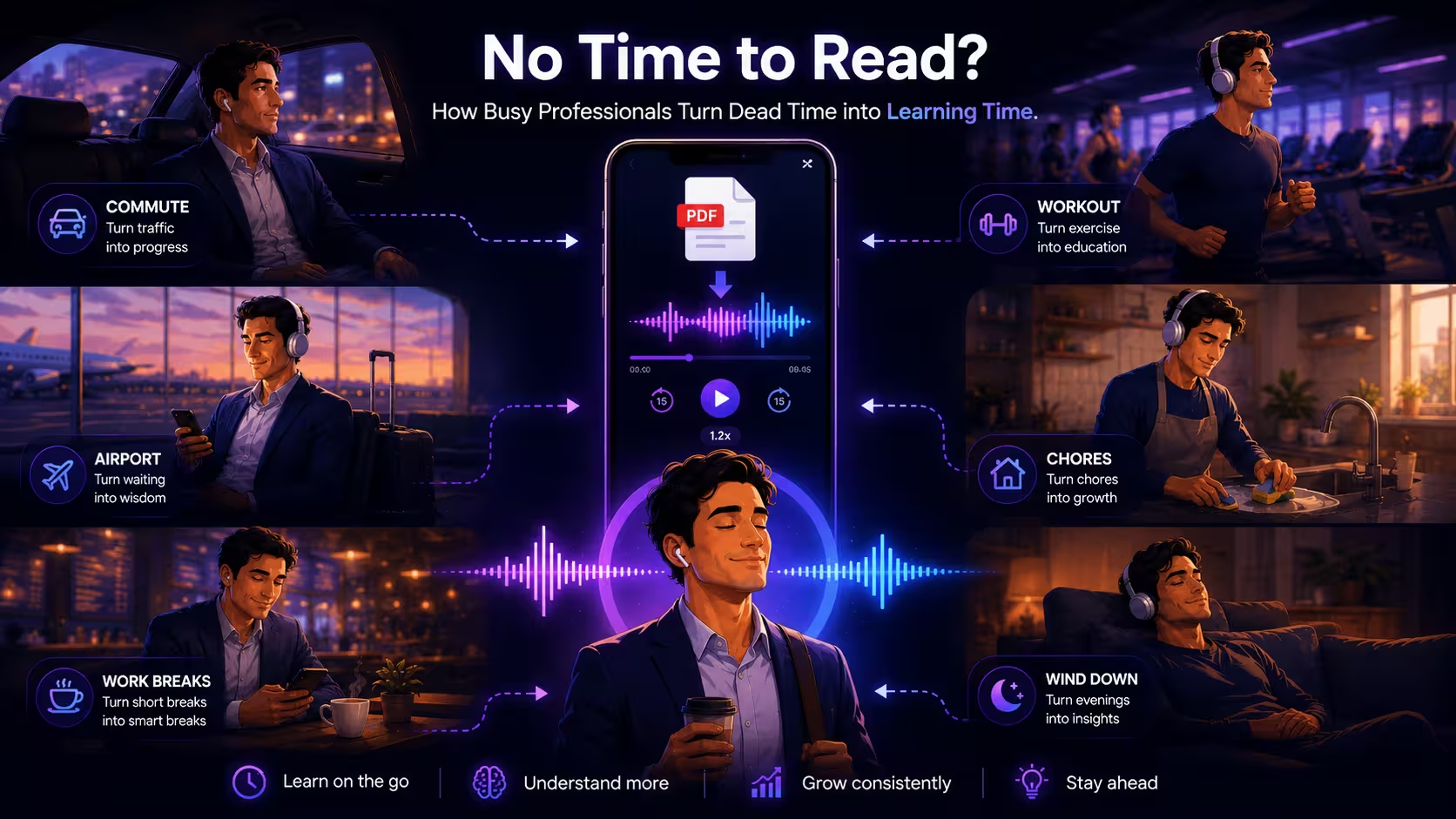
The commute. Whether you are driving, on transit, or walking, the average one-way commute in the United States reached 27.6 minutes in 2019, according to the Census Bureau, and plenty of professionals travel much longer. That is close to an hour or more every day in which your eyes are occupied and your ears are not. Currently: music, radio, or silence.
Exercise. A 40-minute morning run or gym session. A lunchtime walk. An evening cycle. Physical activity for most people is accompanied by music or silence — neither of which produces professional development. Currently: background noise.
Household tasks. Cooking dinner takes 20–40 minutes. Loading the dishwasher. Switching the laundry. A combined 30–45 minutes of evening time that is, from an audio perspective, entirely unoccupied. Currently: the television, half-watched.
Incidental waiting. The queue at the coffee shop. The five minutes before a call starts. The gap between finishing one task and starting another. Individually small, collectively significant. Currently: phone scrolling.
Add it up honestly and the average professional has somewhere between 90 minutes and three hours of daily audio availability — time when listening is not only possible but entirely natural. Most of that time is currently filled with content that produces nothing professionally. What if it was filled with exactly the content your development actually requires?
Current Commute Use
Music you have heard before. News you will skim again on your phone. A podcast that is entertaining but tangential to your field. 50 minutes of potential, consuming nothing professionally useful.
Audio Learning Commute
The industry report from last week. The newsletter you have been meaning to read. The business book chapter. Fifty minutes that arrives at your destination informed and ahead — five days a week, without adding a single item to your calendar.
ReadLoudly tools: PDF Reader · Adjustable Playback Speed · Text to Speech
What Belongs in Your Listening Queue
Not all professional reading is equally suited to audio, and knowing the difference lets you build a queue that actually works.
High-value listening material:
- Industry publications and trade journals make excellent audio content. The argument structure in long-form articles translates cleanly to listening — a clear thesis, developed reasoning, a conclusion. You absorb the perspective without needing charts or sidebars.
- Long-form newsletters from thinkers you follow — the ones that run 800 to 2,000 words and actually say something — are arguably better consumed as audio than text. The length that makes them feel daunting to read makes them exactly the right duration for a commute. If your inbox is full of them, see how to turn a newsletter inbox into an audio queue.
- Business books, particularly non-fiction built around a central idea developed across chapters, map naturally to serial listening. A chapter per commute is a book per month at a pace most professionals can sustain without strain.
- White papers and research reports benefit enormously from audio triage. Listen to the executive summary and key findings sections. You get the substance of the document in 15 minutes of focused listening, which beats a rushed skim-read between meetings.
Material better left to text:
- Anything requiring active reference — contracts, spreadsheets, data-heavy reports where the numbers are the content.
- Documents where you need to annotate, compare, or respond in real time.
- Anything requiring careful signature or approval.
The principle is simple: if the value of the content lives in the ideas rather than the format, it belongs in your listening queue.
How ReadLoudly Fits Into Professional Life
ReadLoudly converts your text-based professional reading — PDFs, articles, uploaded documents — into clean, natural audio you can listen to anywhere. For professionals, the practical advantages go beyond the obvious.
Your Content, Not Someone Else's Curation
Podcast and audiobook ecosystems give you someone else's reading list. ReadLoudly gives you yours.
The industry report your firm just published. The competitor analysis your team put together. The article a trusted contact sent you specifically because it matters to your work. These are not things anyone has narrated for you. They are specific to your field, your role, your professional moment. ReadLoudly turns them into audio on demand — which means your listening time is calibrated to your actual professional development, not to whatever happened to get recorded.
Pace Control as a Productivity Lever
The ability to listen at 1.25x, 1.5x, or faster is not a gimmick. It is a meaningful accelerant.
At the average silent reading rate of about 238 words per minute found in a review of 190 studies, a 2,500-word article takes roughly 10 minutes to read. At 1.5x listening speed, you hear it in about 7. Over the course of a week, that difference compounds into material you could consume but otherwise would not have reached. Most professionals find that 1.25x is comfortable for dense analytical content, and 1.5x works well for material in a familiar domain.
The Context Switch That Isn't One
One of the underappreciated costs of screen-based professional reading is the context switch it requires. To genuinely read a long article, you need to stop doing whatever you were doing, redirect your focus, and sit still. For many professionals managing reactive workflows, the conditions for that rarely materialise during the day.
Audio does not require a context switch. You do not stop commuting to listen. You do not stop exercising. You do not stop making dinner. The information intake folds into what you were already doing, which means it actually happens — consistently, daily — instead of being perpetually deferred.
Screen Reading at Your Desk
Requires a full context switch — stop what you are doing, redirect attention, sit still. In most professional environments, that window never comes. The article stays unread for another day.
Audio with ReadLoudly
No context switch needed. Start the commute, press play. Start the run, press play. The content reaches you because it folds into time you were already spending — no calendar entry required.
ReadLoudly tools: PDF Reader · Text to Speech · Notes to Audio · Adjustable Playback Speed
The Workflow, Practically Speaking
Here is how professionals who have integrated audio learning into their routine actually structure it.
Sunday Queue Build — 10 Minutes
At the end of the weekend, spend ten minutes curating the week's listening queue. Pull the articles you have been meaning to read. Download the reports that came out last week. Add the newsletter issues still sitting unread. Upload them to ReadLoudly. Start Monday with a queue already loaded.
This single habit — building the queue in advance rather than deciding what to listen to in the moment — removes the friction that kills most productivity systems. You do not decide during the commute. You just press play.
The Commute Block
Your commute is the anchor of the system. It happens every day whether or not you choose to use it. Protecting it as audio learning time — rather than phone scrolling, passive news consumption, or music you have heard a thousand times — is the highest-leverage change most professionals can make.
Start with one item per commute. One article. One newsletter. One chapter. Finish it before you arrive. Over five working days, that is five pieces of content absorbed that previously were not.
The Movement Block
If you exercise, keep your queue going. The content that works best here is slightly less dense than what you would listen to in a quiet commute — narrative non-fiction, conversational essays, overview-level industry content rather than granular analysis. Your cognitive resources are partially occupied by physical activity, so match the content accordingly.
The Wind-Down Block
Evening household time — cooking, tidying, getting ready for the next day — is underutilised audio time for most professionals. This is a good window for longer-form content: the business book chapter, the extended essay, the report you have been putting off because it is long and you knew you would never sit still for it.
For the Skeptic: "I Don't Retain Things I Hear"
This objection comes up often, and it deserves a precise answer rather than a dismissal.
Retention from listening is not automatic. Neither is retention from reading, and in one randomised study of 91 adults, people who listened to an audiobook chapter and people who read it as text showed no significant difference in comprehension, either straight away or two weeks later. Both require some engagement, and both produce better results when the listener or reader is actively thinking rather than passively absorbing.
Audio listening requires minimal note-taking for anything you need to retain with precision. When something important surfaces — a statistic, a framework, a name you want to follow up on — a brief voice memo or typed note captures it. This adds perhaps 30 seconds of effort per item and dramatically improves recall.
For most professional content, the goal is not word-for-word retention. It is informed awareness — knowing what a report concluded, understanding the argument a thinker is making, having a view on where an industry is heading. These forms of knowing transfer well through audio. You may not be able to cite the exact figure, but you can speak credibly to the idea. In most professional contexts, that is more than sufficient.
Reading Pile vs Listening Queue: What Each Produces
| Content Type | Silent Reading Pile | Audio with ReadLoudly |
|---|---|---|
| Industry reports | Downloaded, saved, rarely opened — typically read only when the information is already stale | Executive summary and key findings absorbed on the next commute, same week they published |
| Long-form newsletters | Sit in inbox for weeks — the length that makes them valuable also makes them the first thing skipped | Perfect commute or run length — fully absorbed by arrival, ideas ready to use the same morning |
| Business books | Bought, started, abandoned at chapter two — desktop reading rarely survives the reactive workday | One chapter per commute equals a book per month — a sustainable pace most professionals can hold indefinitely |
| Trade journal articles | Skimmed in two minutes between meetings, headline retained, argument missed entirely | Listened at 1.25x during the lunchtime walk — argument fully absorbed, position formed |
| White papers | Downloaded for reference, never read end-to-end — too dense, too long, never quite the right moment | Key sections triaged on the evening wind-down block — a clearer picture of the findings than a rushed skim-read would give |
Start With Tomorrow Morning
Professionals who build a consistent audio learning practice describe a change that goes beyond knowing more. They arrive at conversations with a different quality of engagement — more ideas forming, more connections being made, more genuine curiosity about developments in their field.
They also describe the anxiety around the unread pile quietly dissolving. Not because the pile disappears — it does not — but because they have a system for moving through it that actually works. The newsletter that would have sat in a folder for three weeks gets heard on Tuesday's commute. The report that would never have been read gets processed on Thursday's run. The pile stops being a source of guilt and becomes a resource they are actually using.
You do not need to build the full system today. You need one thing: something in your reading pile that you have been meaning to get to, uploaded to ReadLoudly and ready for tomorrow's commute.
- Upload any PDF, article, report, or document to ReadLoudly PDF Reader — supported formats include PDF, DOCX, EPUB, and TXT
- Paste newsletter text or article excerpts directly into Notes to Audio for instant playback without a file upload
- Set your playback speed — 1.25x for dense analytical content, 1.5x for familiar domains, 1.0x when you want to absorb every word
- Build the Sunday queue before Monday starts — ten minutes of prep produces five days of effortless listening
- Free tier covers the complete professional workflow. Premium plans start at $5/month (Core), $10/month (Plus), $19/month (Pro)