
How Students With Dyslexia and ADHD Are Using AI Voice to Level the Playing Field
The problem was never intelligence. It was always the format. Discover how neurodiverse students are using AI voice to study at their highest level.
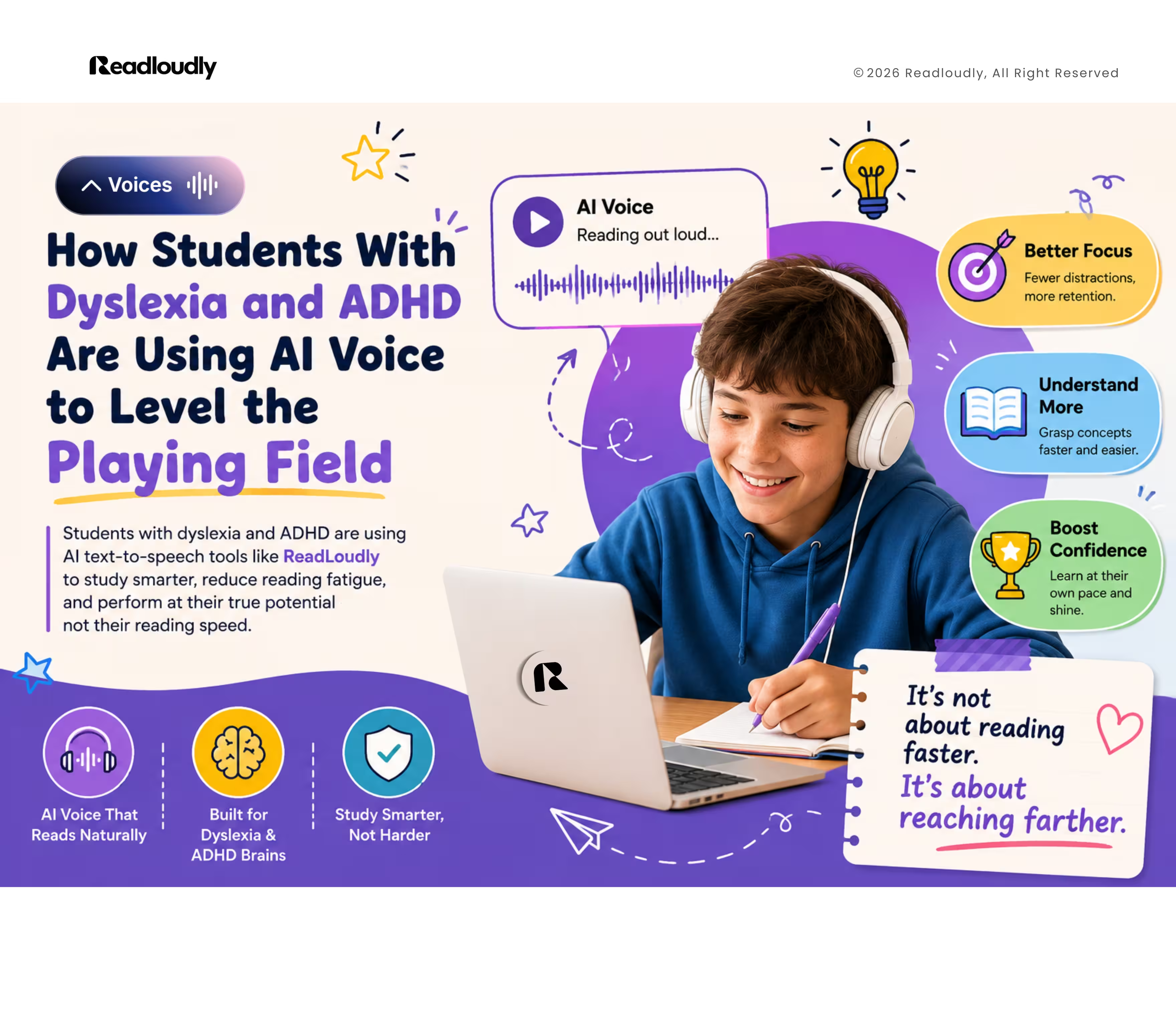
The problem was never intelligence. It was always the format.
Imagine knowing the answer — deeply, clearly — but being unable to get there through a 40-page PDF. Not because the ideas are beyond you. Because the act of reading itself is a wall you have to climb before you can even begin to think.
This is the daily reality for the children with dyslexia — estimates range from 5 to 17.5 percent — and for the 11.7% of US children aged 3 to 17 who, according to the CDC, have a current ADHD diagnosis. Together, these students make up a significant portion of every classroom, lecture hall, and university library — and for decades, the academic system handed them the same tool it gave everyone else: dense text on a page, and a deadline.
AI voice technology is changing that. Not as a workaround. Not as a crutch. As a genuinely better input system for how these students actually process information.
This is the story of how neurodiverse students are using ReadLoudly — and why audio is not just an accommodation anymore. It is an academic advantage.
First, Let's Be Honest About What Reading Feels Like
For a student without reading difficulties, a 30-page chapter is inconvenient. For a student with dyslexia, the same chapter can be exhausting in a way that is hard to explain to people who have never experienced it.
Letters transpose. Words blur. The brain works twice as hard to decode each line — and by the time comprehension begins, the energy to engage with the ideas themselves is already depleted. It is not slow reading. It is a fundamentally different neurological experience of text.
ADHD presents differently but overlaps significantly. The challenge is less about decoding and more about sustaining attention long enough for meaning to accumulate. A paragraph that takes ten seconds to read visually might require three or four re-reads before it registers — not because the student is distracted in a careless way, but because, for some students, static text holds attention less easily than audio does.
The two overlap often. Understood reports that as many as 45 percent of kids with ADHD also have a learning disability, compared with about 5 percent of kids without ADHD, and reading is among the areas affected. That is not a measure of capability. The standard format of academic delivery was simply never designed for the full range of human cognition.
AI voice does not fix neurodiversity. It removes an obstacle that was never a fair test of intelligence in the first place.
What Changes When You Switch to Audio
The shift from visual reading to audio-first study is not subtle. Students who make this transition consistently describe it the same way: like finally being allowed to use the door instead of climbing through the window.
Here is what actually changes:
Decoding disappears as a task
For a student with dyslexia, visual reading requires active, effortful decoding of each word. Audio eliminates that layer entirely. The brain goes straight to meaning. Comprehension — the actual goal — becomes the only cognitive task in play.
Attention locks differently
For many students with ADHD, audio can hold attention more easily than static text on a screen. The pacing of speech — even at faster speeds — creates a rhythm that silent reading does not. Many students report fewer re-reads and less drifting in audio sessions, though the research on this is thinner than the anecdotes (see below).
Fatigue drops significantly
Visual reading for dyslexic students is neurologically expensive. An hour of forced visual reading can leave a student too mentally exhausted to engage with the material at all. An hour of listening at a comfortable pace — during a walk, on a bus, with headphones — uses a different channel and leaves far more cognitive capacity intact for thinking, analyzing, and connecting ideas.
Confidence recovers
This one is harder to quantify but arguably the most important. A student who has been told implicitly for years that they read slowly — that they need extra time, that they need accommodations, that they are behind — starts to carry that as an identity. Audio-first learning breaks that loop. The pace is yours. The voice is clear. The material lands. The grade reflects your understanding, not your reading speed.
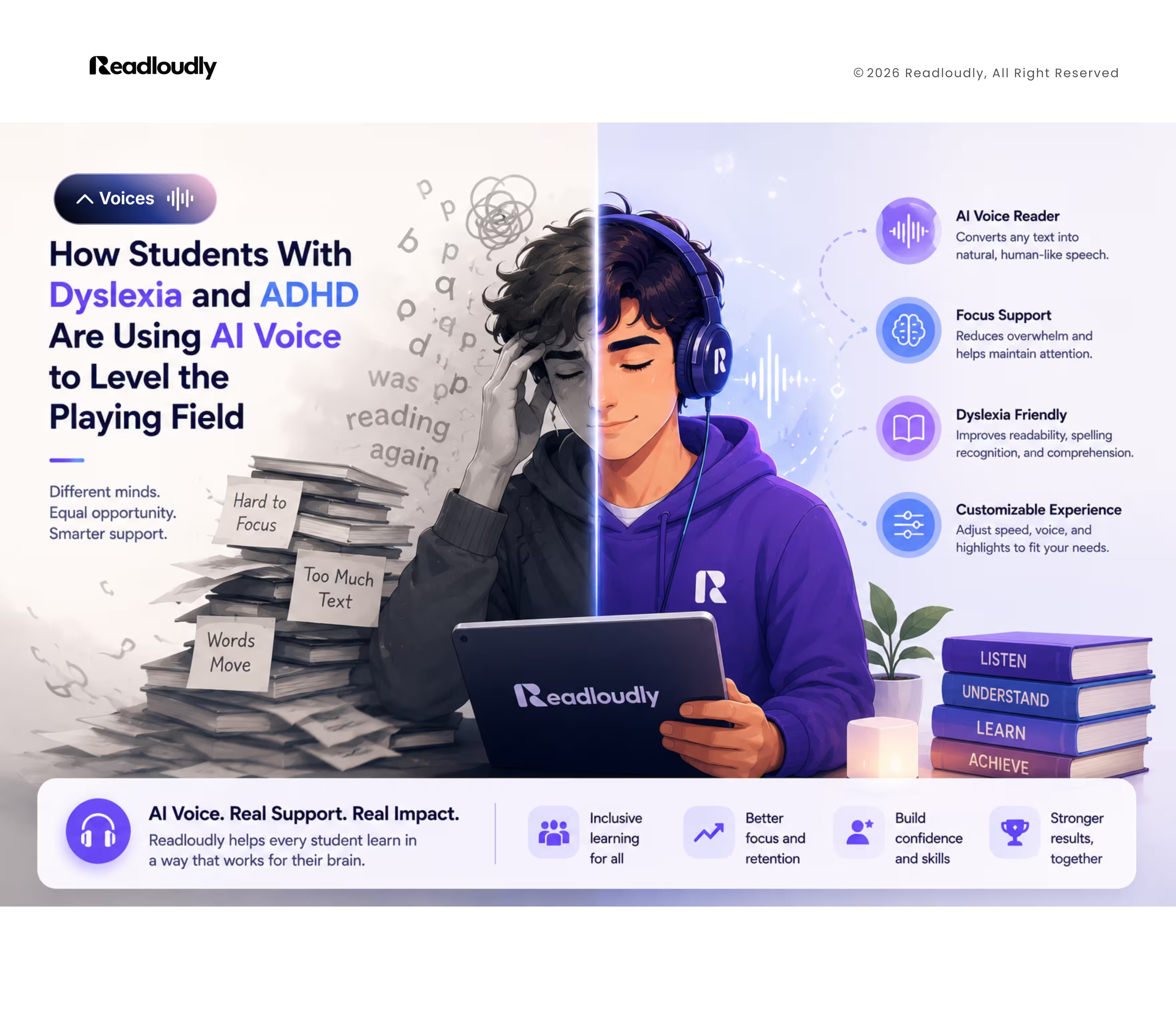
How ReadLoudly Specifically Serves Neurodiverse Students
ReadLoudly was built as a text-to-speech platform, which means its entire design is oriented around turning documents into listenable audio. For neurodiverse students, several specific features matter more than others.
Natural AI voices that do not fatigue
Early text-to-speech tools had robotic, monotone voices that were nearly as hard to follow as visual reading — just for different reasons. ReadLoudly's AI voices are neural and expressive, with natural pacing, correct intonation on questions and lists, and consistent clarity across long documents. The difference between a robotic TTS voice and a neural one is the difference between tolerable and genuinely useful.
For students spending 2–3 hours a day listening to course material, voice quality is not a luxury. It determines whether the workflow is sustainable.
Adjustable speed without pitch distortion
Some students with ADHD find that slightly faster playback — 1.25x or 1.5x — helps their focus. The increased pace keeps the brain engaged and reduces the mental drift that slower speech can invite. ReadLoudly's speed controls adjust pace without distorting pitch, so the voice remains clear and natural even at higher speeds.
For dyslexic students who need time to process, the same control works in reverse — slowing to 0.8x or 0.9x without making the voice sound unnatural.
Every document format, not just clean PDFs
Neurodiverse students deal with the full messy range of academic documents — scanned handouts, photographed whiteboard notes, image-heavy lecture slides, EPUB textbooks, DOCX readings. ReadLoudly handles all of them, including scanned documents through built-in OCR that extracts text from image-based files before narrating.
The student does not need to manage format compatibility. Upload it, and it becomes audio.
- PDF Reader — course readings, journals, handouts
- Scanned PDF Reader — photographed notes, library scans
- EPUB Reader — textbooks and assigned reading
- DOCX Reader — professor-shared documents and essays
Mobile access
The best study session for a student with ADHD is often not at a desk. Movement genuinely helps — walking while listening, cycling, doing light exercise. ReadLoudly works fully in any mobile browser, which means the commute, the gym, the campus walk between lectures are all study time.
Open it in a browser on your phone and the walk between lectures becomes study time. No app install required.
Real Study Workflows for Neurodiverse Students
The Pre-Lecture Listen (for ADHD students)
The single most effective strategy for ADHD students is exposure before instruction. Walking into a lecture having already heard the chapter — even at 1.5x speed in a fairly passive way — means the lecture itself becomes a review session rather than a first encounter. Familiar material holds attention. New material alone does not.
Workflow:
- Upload the assigned chapter PDF to ReadLoudly the evening before class
- Listen at 1.25–1.5x speed during the morning commute or breakfast
- Do not take notes — just absorb
- Walk into lecture with familiar scaffolding already in place
- Use class time to deepen rather than build from zero
This workflow alone shifts the classroom experience dramatically for ADHD students who struggle to absorb new material in real time under lecture conditions.
The Chunked Review (for dyslexia)
Long reading sessions are unsustainable for many dyslexic students. The solution is not fewer readings — it is shorter, more frequent listening sessions with deliberate breaks.
Workflow:
- Upload the full document to ReadLoudly
- Use chapter navigation to identify natural break points
- Listen in 20–25 minute blocks — no longer
- After each block, write three bullet points from memory (not re-listening)
- Take a 10-minute break before the next block
- Resume
This mirrors the Pomodoro technique but adapted for audio. Self-testing after each block is among the best-supported study techniques: a major review of ten learning techniques rated practice testing as high utility and rereading as low utility.
The Night Before: Summary to Audio
When exam preparation time is limited — which is almost always — the fastest review strategy is not re-reading full documents. It is listening to dense summaries.
Workflow:
- Open your revision notes or a chapter summary in ReadLoudly
- Use Notes to Audio to convert them to listenable format
- Listen through the full summary once at normal speed
- Listen again at 1.5x, flagging anything that does not land clearly
- Revisit only flagged sections in detail
This workflow is especially effective for students with ADHD who find re-reading notes visually almost impossible under exam stress — the audio format bypasses the visual friction and delivers the content directly.
The Scanned Handout Fix
Professors hand out physical worksheets. Library books get photographed. Slides are shared as image-based PDFs. For dyslexic students, these image files are completely inaccessible to TTS tools — unless those tools include OCR.
Workflow:
- Photograph or scan the physical document
- Upload directly to ReadLoudly's Scanned PDF Reader
- OCR reads the text out of the image
- Listen immediately — no manual transcription required
What used to take a student 20 minutes of manual transcription or a formal accessibility request to the disability office can now take a couple of minutes.
The Accommodation System Is Broken for a Reason
Most universities offer accommodations for students with dyslexia and ADHD — extra time on exams, note-taking assistance, access to audio recordings. These systems exist for a reason and remain valuable. But they come with friction.
Getting formally diagnosed. Submitting paperwork. Waiting for approval. Meeting with disability offices. Re-submitting each semester. Explaining the same needs to each new professor. Managing the social dynamics of being visibly accommodated in a peer group that may not understand.
The practical reality is that many students who would benefit from accommodations never access them. Some are undiagnosed. Some were diagnosed but find the request process more stressful than the condition itself. Some are in institutions where the support infrastructure is underfunded or slow.
AI voice tools like ReadLoudly operate entirely outside this system. No diagnosis required. No paperwork. No waiting. No conversation with a professor. The student uploads a document and presses play. The accommodation is self-administered, instant, and private.
This is not a replacement for formal support structures — those matter, and students who qualify should access them. But for the significant number of students who fall through the cracks of the official system, self-directed audio tools represent a meaningful, accessible alternative that requires nothing beyond a browser.
What the Research Says About Audio Learning and Neurodiversity
The evidence behind audio-first learning for neurodiverse students is substantial and consistent:
Dyslexia research shows a real but modest benefit. A meta-analysis of text-to-speech and related read-aloud tools for students with reading difficulties put the average effect on reading comprehension at d = 0.35 (95% CI 0.14 to 0.56; Wood et al., 2018), and its authors concluded that the tools may assist students while calling for more studies. The likely mechanism is straightforward — removing decoding load frees cognitive resources for comprehension, which is where intelligence actually operates.
ADHD research is thinner than most articles admit: there is no meta-analysis of text-to-speech conducted specifically in ADHD populations, and listening comprehension is itself affected in ADHD: in a community sample of boys aged 9 to 12, those with ADHD took in factual content as well as their peers but had more trouble drawing inferences and keeping track of instructions (McInnes et al., 2003). The honest claim is narrower — audio removes the decoding load, not the attention load. Pairing it with movement, such as listening during a walk, is a widely used strategy that many students find helps, rather than a settled research finding.
Bimodal learning — following along with text while hearing it read aloud — is the piece most often oversold. The largest synthesis of it, covering 30 studies and 1,945 readers, found reading while listening beat reading alone by only g = 0.18, and by a statistically non-significant g = 0.06 when readers set their own pace (Clinton-Lisell, 2023). Treat it as a comfort and tracking preference rather than a comprehension boost. ReadLoudly's interface supports it either way: text is visible while the AI voice narrates, so students can track visually if they choose or listen purely if they prefer. We set out the full picture, including where the evidence runs out, in our guide to what the evidence actually shows about text-to-speech for dyslexia and ADHD.
None of this requires specialized software, clinical settings, or formal intervention. It requires a browser and a document.
A Note on Identity: This Is Not a Limitation
There is a persistent cultural narrative around learning differences that frames them as deficits to be managed. Dyslexia as something to overcome. ADHD as a disorder to be medicated into compliance with neurotypical norms.
That framing is both inaccurate and harmful. Dyslexia occurs at all levels of intelligence, and the Yale Center for Dyslexia & Creativity notes that many dyslexic people are fast, creative thinkers even though they read slowly. Many people with ADHD describe strengths too, such as hyperfocus and pattern recognition, though experiences vary widely.
The issue is not the way these students think. The issue is the single format — dense static text — that academic systems have defaulted to for centuries, and the assumption that struggling with that format means struggling with ideas.
Audio learning does not accommodate a deficit. It matches a different — and often very powerful — cognitive profile to an input system that works for it.
ReadLoudly does not fix anything. It removes an obstacle that was never a fair measure of intelligence in the first place.
Getting Started: Your First Week With ReadLoudly
If you are a student with dyslexia, ADHD, or both — or if you suspect you may be and have never been formally diagnosed — here is a practical first week:
Day 1: Upload one chapter of your hardest current reading to ReadLoudly's PDF Reader. Listen at 1.0x speed with headphones. Notice how comprehension feels compared to visual reading.
Day 2: Try the same chapter at 1.25x. Adjust until the pace feels natural — not rushed, not slow enough to drift.
Day 3: Apply the workflow to a different subject. Notice which voice and speed combination works best for different types of content.
Day 4: Try listening during a walk or light movement. Notice whether focus holds differently from sitting at a desk.
Day 5: Upload your revision notes to Notes to Audio. Listen back as a review session. Compare retention to re-reading.
Day 6 & 7: Rest. Let the week's material settle. Notice whether the material stayed with you compared to previous study methods.
One week. No cost. No setup. Just a browser and a document.
Conclusion: The Playing Field Was Never Level. Now It Can Be.
For too long, academic success for neurodiverse students has been measured by their ability to navigate a format that was never designed for them. The student who reads slowly is not less intelligent. The student who cannot sustain focus through 50 pages of dense text is not lazy. They are running a different operating system — and for most of academic history, the hardware they were given simply was not compatible.
AI voice technology does not solve every challenge neurodiverse students face. But it removes one of the most persistent and unnecessary ones: the assumption that learning must happen through the eyes.
Listening is not a lesser form of engagement. For millions of students, it is the form where their full intelligence finally has room to operate.
ReadLoudly is free to start. Your first document is one upload away.
The goal was never to read like everyone else. The goal was always to learn at your highest level.