
Audiobooks vs Text-to-Speech: Which Is Actually Better for Your Brain?
Both turn words into audio. Both sit on your phone. But they affect comprehension, retention, and emotional engagement in measurably different ways — here's what the science actually says.
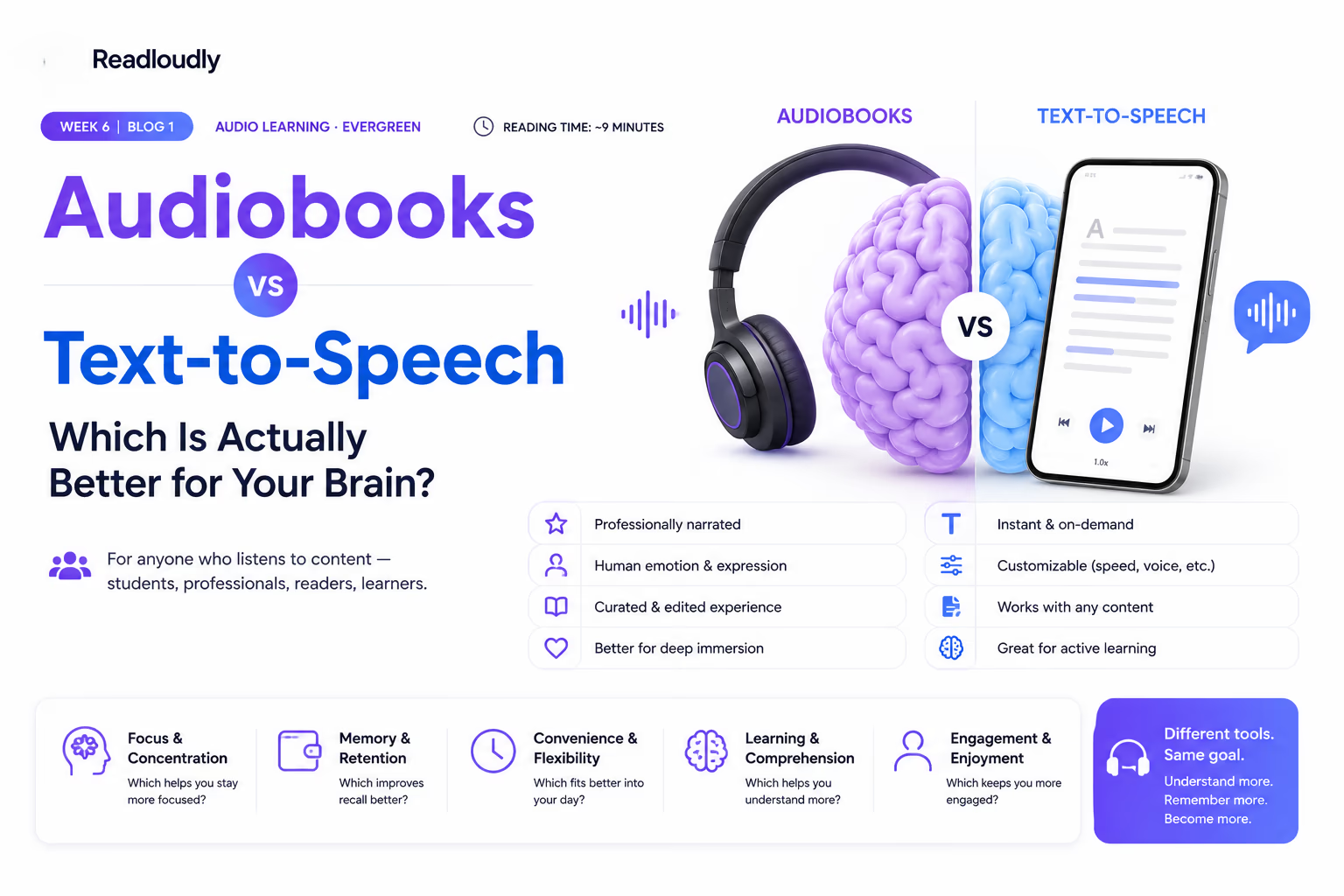
"Two technologies. Both turning written words into audio. Both claiming to make you smarter, more informed, and better read."
The audiobook industry crossed $8 billion in global revenue in 2025 and is growing at 25% year over year. At the same time, AI text-to-speech has become so natural-sounding that blind listening tests now routinely fail to distinguish it from human narration — at least for non-fiction content.
Two technologies. Both turning written words into audio. Both sitting on your phone. Both claiming to make you smarter, more informed, and better read.
But are they actually the same thing? And if not — which one is genuinely better for how your brain learns, retains, and processes information?
The answer is more interesting than a simple winner. And it depends on something most people haven't considered.
First: What Are We Actually Comparing?
Before the science, a clear definition — because these terms get used interchangeably when they shouldn't be.
Audiobooks
Pre-recorded human narrations of books and long-form content. A professional narrator records the entire text. The result is a fixed, produced audio experience with consistent pacing, emotional delivery, character voices, and professional sound quality. You buy or subscribe to access what has been recorded. You cannot listen to a book that hasn't been narrated.
Text-to-Speech (TTS)
Software that converts any written text into audio on demand using AI-generated voices. PDFs, articles, emails, research papers, your own notes — all of it can be converted instantly using tools like ReadLoudly's PDF Reader or Text to Speech tool. You control the speed, the voice, and — critically — the content. Anything written can become audio.
These are not two versions of the same thing. They are different tools solving different problems. The question of which is "better for your brain" depends entirely on what your brain is trying to do.
How Your Brain Processes Audio: The Shared Foundation
Here is the first important finding: reading and listening engage the same core language networks in the brain.
When you read a sentence, your visual cortex processes the written symbols, your auditory cortex activates in response to the subvocalization most people do silently as they read, and your language comprehension networks — centered in the left temporal and frontal lobes — extract meaning. When you listen to the same sentence spoken aloud, the visual processing step is bypassed, but the same language comprehension networks activate in essentially the same way.
Research from Maastricht University on how literacy changes the brain found that learning to read actually rewires auditory processing — the brain builds direct connections between visual text representations and spoken language representations. For fluent adult readers, reading and listening are processed by deeply overlapping neural circuitry. Neither is cognitively superior by design.
What differs between listening to an audiobook and listening to AI text-to-speech is not the pathway of processing. It is the quality, speed, and emotional texture of the audio signal itself — and how those variables interact with comprehension and retention.
Round 1: Comprehension — Which Do You Actually Understand Better?
The research here is nuanced and worth paying attention to.
A parallel corpus analysis comparing text and audio comprehension across multiple content types found that for complex technical or medical texts, reading comprehension consistently outperformed audio — with comprehension accuracy differences as significant as 76% for text versus 58% for audio on journal-level content.
But — and this is the crucial qualifier — that gap narrows dramatically for simpler, more narrative-driven content. For conversational or story-based material, the comprehension difference between reading and listening approaches negligibility.
For audiobooks — which typically cover narrative fiction, memoir, self-help, and popular non-fiction — the content is usually at a complexity level where audio comprehension holds up well. The professional narrator's pacing, pausing, and emphasis also actively support comprehension in ways that raw text cannot. Vocal cues do the work that italics, paragraph breaks, and punctuation do on the page.
For TTS — which is often used for dense academic papers, technical reports, and industry analysis — the content is frequently at the more complex end where the comprehension gap can be more significant, particularly on a first pass. This is not a fatal flaw; it is a characteristic that shapes how TTS should be used. With ReadLoudly's PDF Reader, a first audio pass is excellent for orientation and triage — you identify which sections demand a deeper, slower listen before diving in. For research papers specifically, see our guide on how to read research papers aloud effectively.
Comprehension verdict
Audiobooks have a slight edge for narrative and story-based content. TTS is competitive for conversational text and performs well for orientation reading of complex material. Neither is comprehensively superior — the content type determines the appropriate tool.
Round 2: Retention — What Actually Sticks?
Memory researchers have known for decades that multi-modal learning — encountering information through more than one sensory channel — produces stronger retention than single-modal exposure.
Research consistently shows that concepts presented in dual modality (seen and heard simultaneously) produce enhanced memory recall compared to words presented in only one modality. This is the principle behind following along with written text while listening — the audio and visual signals reinforce each other through separate memory encoding pathways. We cover the science behind this in depth in our guide on how to improve reading retention.
Audiobooks are typically consumed without the text in front of you — during a commute, a run, while cooking. The experience is single-modal: audio only. The narrator's emotional delivery, intonation, and character differentiation do support memory encoding in a unique way. Research confirmed a "human emotional intimacy effect" from human voices in audiobooks — listeners form stronger emotional associations with content narrated by a human voice compared to synthetic speech, which can translate to stronger episodic memory for the material.
TTS, when used with a highlighting feature that follows the text in sync with the audio (available in ReadLoudly's PDF Reader), creates a dual-modal experience — you are reading and listening simultaneously. This combination can produce superior retention to either reading or listening alone. Additionally, TTS's speed control means you can cover material more often within the same time budget — and repetition is one of the most reliable drivers of long-term retention known to learning science.
Retention verdict
Human audiobook narration may produce stronger emotional memory encoding for narrative content. TTS with simultaneous text display can produce superior factual retention through dual-modal learning. For review and repetition — where speed matters — TTS has a structural advantage.
Round 3: Emotional Engagement — The Human Voice Effect
This is where audiobooks have their clearest and least contestable advantage.
Research on voice perception shows that variations in vocal qualities — pitch, timbre, rhythm, pacing — shape listeners' emotional engagement, comprehension, and immersion, particularly in literary narratives that rely heavily on atmosphere and character differentiation. This is not a subjective preference. It is a measurable neurological response.
A skilled human narrator does things that even the best AI voice cannot fully replicate in 2026: they interpret. They make choices about where to apply irony, where to soften, where to build tension, where to let silence do work. They understand the text as a whole and deliver each sentence in relationship to everything that came before and after it.
For non-fiction, the picture is more complex. AI audiobook narration in 2026 — including the voices available through ReadLoudly's AI Voice Generator — is considered indistinguishable from human narration for non-fiction, self-help, business, and educational books, while human narrators still hold an advantage for fiction with multiple characters and literary works where vocal artistry drives the listening experience.
Emotional engagement verdict
Human audiobook narrators win for fiction and emotionally resonant storytelling. For non-fiction, the gap has narrowed substantially as AI voice quality has improved, and is largely imperceptible for most listeners.
Round 4: Content Access — The TTS Structural Advantage
This round is not close.
An audiobook exists only if a publisher decided it was worth recording, found a narrator, paid for the production, and made it available for sale or subscription. The global audiobook catalogue — while growing rapidly — covers a small fraction of all written content. Most academic papers have never been narrated. Most industry reports have never been narrated. Most journalism, most newsletters, most of the written material that professionals and researchers and students actually need to engage with — none of it exists as an audiobook.
TTS has no such limitation. Any text that can be copied or uploaded can be converted to audio:
- Upload a PDF directly to ReadLoudly's PDF Reader — research papers, reports, textbook chapters, industry analysis
- Paste any article, newsletter, or web content into the Text to Speech tool and listen immediately
- Open ebooks, EPUB files, and MOBI documents in the Ebook Reader with natural voice playback
- Convert your handwritten notes, lecture transcripts, and study materials using Notes to Audio
- Browse every conversion tool in one place at ReadLoudly Tools
The research paper your professor assigned, the competitor analysis your team produced, the newsletter from a thinker whose work you value, the chapter of a textbook your institution hasn't purchased an audio licence for — all of it becomes listenable in under a minute. For a deeper look at listening to PDFs specifically, see our guide on how to listen to PDFs online.
This is not a minor practical difference. For most working professionals, researchers, students, and anyone who needs to engage with text that wasn't written for a mass audience, audiobooks simply cannot serve the primary use case. The content they need does not exist in audiobook form.
Content access verdict
TTS wins comprehensively. It can convert any written text to audio on demand. Audiobooks are limited to what has been professionally recorded and commercially distributed.
Round 5: Speed and Control — The Learning Variable
Both technologies offer speed control, but the practical experience is very different.
Traditional audiobooks, recorded at 150–160 words per minute for optimal comprehension, can be sped up to roughly 1.5x before distortion and unnatural phrasing become genuinely fatiguing. Most audiobook listeners find 1.25x comfortable for extended listening.
TTS systems like ReadLoudly are built for variable speed from the ground up. The AI voice is generated, not recorded, which means speed adjustment produces clean audio at 2x, 2.5x, and even 3x without the chipmunk distortion that affects recorded speech at high speeds. For experienced listeners, 1.5x to 2x is entirely sustainable for familiar content. Our guide on increasing reading efficiency covers the optimal speed strategy for different content types.
| Content | Audiobook time | ReadLoudly at 1.5x | ReadLoudly at 2x |
|---|---|---|---|
| 300-page non-fiction book | ~9 hours | ~6 hours | ~4.5 hours |
| 20-page research paper | Not available as audiobook | ~20 min | ~15 min |
| 5,000-word industry report | Not available as audiobook | ~15 min | ~11 min |
Speed and control verdict
TTS wins for flexible speed management and efficiency. Audiobooks offer less control but are built for a listening pace that supports comprehension for narrative content.
Round 6: Accessibility — Who Benefits Most
This is the area where TTS has had its most profound impact and where the case for it is most compelling.
For readers with dyslexia, ADHD, visual impairments, or processing differences that make sustained visual reading difficult or impossible, TTS does not just offer a convenient alternative — it offers access to content that would otherwise be inaccessible. The ability to listen to any text at a comfortable pace, with highlighting that tracks the spoken word, provides a form of multimodal support that research consistently shows improves comprehension and engagement for neurodiverse learners. We've written extensively on this in our guides on AI voice generators for dyslexia and ADHD and how AI voice levels the playing field for students with learning differences.
Audiobooks serve accessibility too, but with the fundamental limitation that they only cover content that has been recorded. A student with dyslexia who needs to engage with a journal article for a research paper cannot find an audiobook version. ReadLoudly's PDF Reader solves that problem immediately — upload any document and have it read aloud with synchronized highlighting, no recording required.
Additionally, TTS is typically dramatically more affordable than audiobooks. Access to ReadLoudly's Text to Speech that handles unlimited documents is available on the free plan. Comprehensive audiobook access through services like Audible or Scribd costs $10–$15 per month and still restricts you to the catalogue.
Accessibility verdict
TTS wins substantially for breadth of access, cost, and support for neurodiverse readers. Audiobooks win for the richness of professionally produced accessible content within their catalogue.
The Finding Nobody Talks About: They're Complementary, Not Competing
Here is the insight that the audiobooks vs TTS framing obscures: for most people, the right answer is not a choice between them. It is an understanding of which tool serves which purpose.
Use audiobooks when:
- You're consuming narrative fiction where emotional delivery and character voices matter
- You want a curated, produced listening experience you can lose yourself in
- The content you want exists as a professionally narrated audiobook
- You value the interpretive choices a skilled narrator makes with the material
Use TTS (ReadLoudly) when:
- You need to listen to PDFs, research papers, reports, or textbooks that were never narrated
- You want to convert any article or web content to audio instantly
- You're studying and want dual-modal learning — listening while reading the text
- You need to convert your own notes to audio for review sessions
- You want to listen to your own writing to catch what your eyes miss
- You have accessibility needs that require text-to-audio for any document, not just recorded titles
These are different jobs. Using only audiobooks means most of the written content in your professional or academic life never gets heard. Using only TTS for fiction means missing the emotional and interpretive depth a skilled narrator adds to a story.
The most informed audio listeners — the ones who consistently report feeling well-read, well-informed, and genuinely engaged with the material they consume — use both.
What the Research Ultimately Says
Drawing together the evidence — neither audiobooks nor text-to-speech is categorically "better for your brain." What the research establishes is this:
| Dimension | Audiobooks | TTS (ReadLoudly) |
|---|---|---|
| Comprehension | Stronger for narrative content | Competitive; calibrate speed to complexity |
| Retention | Stronger emotional memory encoding | Superior with dual-modal (audio + text highlight) |
| Emotional engagement | Clear advantage for fiction | Increasingly competitive for non-fiction |
| Content access | Limited to recorded catalogue | Any written text, on demand |
| Speed control | Max ~1.5x before distortion | Clean audio at 2x, 2.5x, 3x |
| Accessibility | Rich experience within catalogue | Any document, any learner, lower cost |
The brain does not care which technology produced the audio signal. It cares whether the signal is clear, comprehensible, appropriately paced, and engaging enough to sustain attention. In 2026, both technologies can meet that bar — for different content, in different contexts, for different purposes.
A Practical Starting Point
If you already use audiobooks and are considering TTS: start by uploading the reading that currently sits unread — the industry report, the academic paper, the newsletter — to ReadLoudly's PDF Reader and listen to it the way you would an audiobook. The content is different. The experience is more similar than you might expect.
If you use TTS and haven't given audiobooks a serious chance: find a non-fiction book on a topic you care about deeply, narrated by the author or a high-quality narrator, and listen at a pace slightly slower than you normally would. Notice what a skilled human voice does to material you already understand intellectually.
Both will change your relationship with the written word.
ReadLoudly is built specifically for the TTS use case — converting your documents, PDFs, and written content into natural audio you can listen to anywhere. Try the PDF Reader for uploaded documents, the Text to Speech tool for articles and pasted content, the Ebook Reader for EPUB and MOBI files, and Notes to Audio for your own study materials. The full suite is available at ReadLoudly Tools.
The audiobooks vs TTS debate will keep running. But the best listeners stopped choosing sides a while ago.