
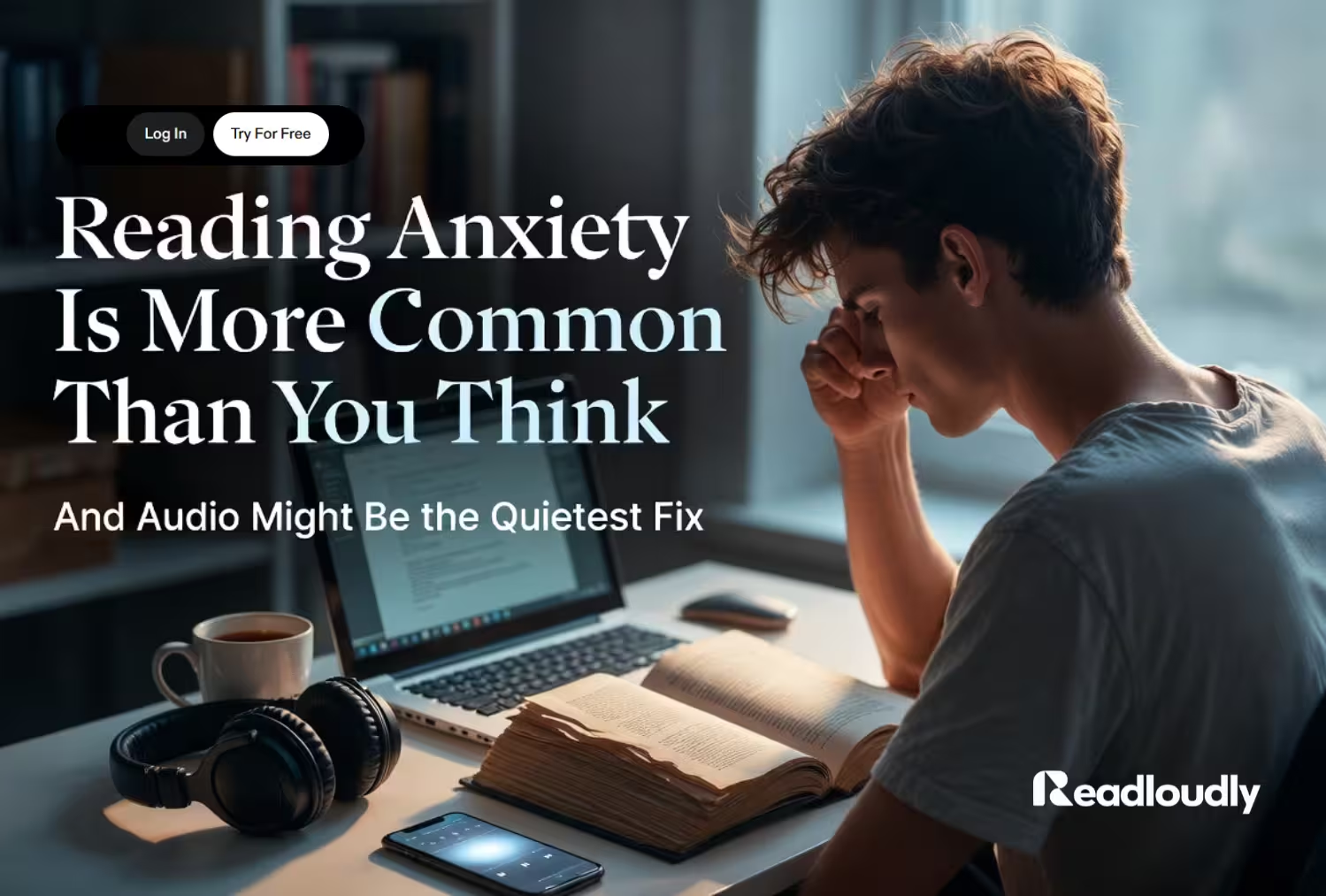
Reading Anxiety Is More Common Than You Think — And Audio Might Be the Quietest Fix
You read the paragraph. Then you read it again. If a block of text can trigger real physical tension before you've read a single word, you're not lazy and you're not unintelligent — you're experiencing something common but rarely named: reading anxiety.
"The cognitive load of managing the physical symptoms of anxiety often leaves little room for the actual processing of text, creating a feedback loop of frustration."
You read the paragraph. Then you read it again.
Your eyes track the words, but your brain refuses to anchor them. The silence in the room feels loud. A familiar tightening starts in your chest. You look at the length of the document — a sea of unrelenting black text on a harsh white background — and a wave of exhaustion washes over you before you have even finished the first page.
This isn't just fatigue. It's not laziness. And it's definitely not a lack of intelligence. If you have ever felt a sense of dread or physical tension when faced with a block of text, you are experiencing something deeply common but rarely discussed: reading anxiety.
Reading Anxiety Has a Name — And It Is More Common Than You Think
We live in a text-dominant society. From crucial work emails and dense contracts to the news and social media, literacy isn't just about the ability to decode letters — it's an expectation of endurance. But for a significant portion of the population, the act of visual reading is fraught with neurological friction.
Reading anxiety isn't a single diagnosis. It's an umbrella term for the emotional and physical distress triggered by reading, often stemming from underlying, sometimes undiagnosed, cognitive or neurological differences. It frequently overlaps with dyslexia and ADHD, processing disorders, and general anxiety — but it can also show up entirely on its own, in readers with no other diagnosis at all.
The Scale of the Challenge
Reading anxiety is not a rare or fringe experience. It is common enough that most people who feel it assume they are alone in it — which is precisely why it goes so under-discussed.
48%
of US adults report feeling anxious or overwhelmed when faced with complex or lengthy written materials
42.5M
US adults live with an anxiety disorder — often exacerbating existing reading difficulties
60%
of college students experience overwhelming stress specifically related to reading volume
Nearly half the adult population, tens of millions of people with diagnosed anxiety disorders, and a clear majority of college students — this is not a niche accommodation issue. It is a mainstream experience hiding behind labels like "procrastination," "poor focus," or "I'm just not a reader."
The Five Forms Reading Anxiety Takes
Reading anxiety does not look the same for everyone. Here are the most common forms — some of which you may recognise in yourself even if you have never put the name "anxiety" to them.
1. The Re-Read Loop
The experience described above: reading the same passage multiple times without absorbing it. The eyes move, the words register visually, comprehension does not occur. This is the most commonly reported form of reading anxiety, and one of the most frustrating — because the effort is clearly being made, and it is not producing results.
2. Reading Aloud Anxiety
The specific dread of being asked to read aloud — in a classroom, a meeting, a group setting. Research on public speaking anxiety and reading-aloud anxiety shows overlapping neurological activation. The performance pressure of reading for an audience — the awareness of being evaluated for fluency, pronunciation, and pace — can be significant enough to disrupt both the reading itself and the comprehension that follows.
3. The Avoidance Pile
The book on the nightstand that has been opened and put down for three months. The email marked unread and reopened daily without being acted on. The report that needs to be read before tomorrow's meeting. The avoidance is not laziness — it is the behavioural consequence of a task that has been associated with discomfort often enough that approaching it now produces anticipatory anxiety before the reading even begins.
4. Comprehension Collapse Under Pressure
The experience of understanding material perfectly in a low-pressure context and then apparently forgetting everything when tested, timed, or asked to demonstrate that understanding. Timed reading measures can introduce additional pressure, potentially elevating the impact of general anxiety on achievement — the knowledge was there; the clock made it inaccessible.
5. Text-Based Overwhelm
The paralysis that comes from encountering a reading list, a long document, or a dense stack of material that needs to be processed. Not the anxiety of a single text, but the anxiety of the volume — the feeling of drowning before you have even begun. This form is particularly common among professionals with large reading backlogs, researchers with extensive literature to cover, and students in intensive reading-heavy courses.
What Anxiety Does to a Reading Brain
When anxiety activates, the brain's amygdala — the emotional processing centre — takes over, diverting resources away from the prefrontal cortex, which is responsible for complex tasks like reading comprehension and sustained focus.
"The cognitive load of managing the physical symptoms of anxiety often leaves little room for the actual processing of text, creating a feedback loop of frustration."
This creates a debilitating cycle that many readers find impossible to break without an external tool:
Anxiety activates
A block of text triggers a stress response before a single word has been processed for meaning.
Cognitive load increases
Mental energy is spent managing the stress response instead of decoding and processing the text.
Comprehension decreases
Meaning is lost as attention fragments between the content and the discomfort, leading directly back to the re-read loop.
Frustration peaks
The cycle repeats on the next document, deepening the sense of dread and reinforcing the avoidance that started it.

Why Audio Works Differently on the Anxious Reading Brain
Text-to-speech doesn't treat reading anxiety by making the anxiety disappear. It works by removing the specific triggers that set the cycle in motion in the first place. That distinction matters for what you should expect from it: the measured benefit of text-to-speech is on access, reading rate, effort and finishing the material rather than a guaranteed comprehension gain, which our evidence-based guide to text-to-speech for dyslexia and ADHD covers in full.
1. Removes performance framing
Listening shifts the task from performance to reception. There is no fluency to be judged, no pace to be evaluated, no audience — real or imagined — watching how well you decode the page.
2. Removes the decoding demand
Audio delivers language directly, skipping the symbol-to-sound conversion that consumes so much cognitive bandwidth for an anxious reader. The words simply arrive as language, already decoded.
3. Sets an external, consistent pace
A steady, predictable playback speed removes the self-monitoring — "am I reading too slowly, am I falling behind" — that often accelerates the anxiety spiral during silent reading.
4. Removes social evaluation
Listening happens privately, with headphones, on your own device. No one is watching you struggle with a paragraph — which removes the anticipatory dread that builds before reading even begins.
5. Pairs naturally with movement
Audio can be consumed while walking, stretching, or doing a low-focus task — and physical movement is independently associated with reduced anxiety. Reading while walking is not possible. Listening while walking is trivial, and combines two anxiety-reducing effects at once.
How ReadLoudly Specifically Helps
ReadLoudly is a text-to-speech platform built to remove exactly the frictions described above, not just to read text aloud.
Variable speed control
Start at 0.9x if full-speed audio feels like too much too soon. There is no "correct" speed — only the one that lets you stay with the content instead of bracing against it.
Synchronised text highlighting
Audio and visual text move together, giving you a redundant channel — if attention drifts from one, the other keeps you anchored to your place in the document.
Pause and rewind without penalty
Missed a sentence? Rewind 15 seconds. There is no judgment, no visible sign to anyone else that you needed to hear it twice — the tool simply repeats it.
Any content, not just books
Emails, PDF reports, research papers, contracts, assignment briefs — the avoidance pile is rarely made of novels. ReadLoudly reads whatever is actually sitting unread.
No registration required to try
Low-friction entry matters when the task itself already carries resistance. You can upload a document and start listening in under two minutes, with no account, no commitment, and nothing to explain to anyone.
ReadLoudly tools: Text to Speech · PDF Reader · Ebook Reader
The Quiet Entry: How to Start
The most useful starting point for anyone whose reading anxiety has produced a significant avoidance pile is not to tackle the most daunting item first. Instead, start with something low-stakes — a short article, a single email, or a chapter of a book you have already read. This allows you to build confidence in the tool without the pressure of high-stakes comprehension.
"Gradual exposure to reading tasks in a controlled, low-anxiety environment is a key component of cognitive behavioral approaches to reading difficulties."
Once one document has been listened to comfortably, the next one is easier — and the one after that, easier still. The avoidance pile does not need to be cleared in a single sitting. It needs one document to stop being the thing you dread.
Who This Is For
Students
Facing immense reading volumes and comprehension pressure under exam and assignment deadlines, where the anxiety compounds with the workload itself.
Professionals
Overwhelmed by inbox backlogs, long reports, and industry literature that keeps arriving faster than it can be read without dread setting in first.
Neurodivergent adults
Managing ADHD, dyslexia, or processing differences where reading anxiety is a frequent, often unacknowledged, companion to the primary diagnosis.
Anyone feeling overwhelmed
No diagnosis required. If reading has quietly become a barrier rather than a bridge, that alone is reason enough to try a different channel.
The Quietest Fix
Reading shouldn't be a battle. By shifting the sensory input from visual decoding to auditory reception, you can bypass the neurological friction that triggers the anxiety in the first place.
Audio offers a quiet, low-pressure alternative — a way to absorb information at your own pace, on your own terms. It isn't just a workaround. It's a different way to access the same knowledge, without the toll.
Start Listening — FreeWhat This Is Not
This blog is not mental health treatment, nor a substitute for professional medical advice, diagnosis, or treatment. Reading anxiety is a complex experience that can be tied to various neurological and psychological factors. While audio tools like ReadLoudly provide significant accessibility support, anyone experiencing severe distress should consult a qualified professional.