
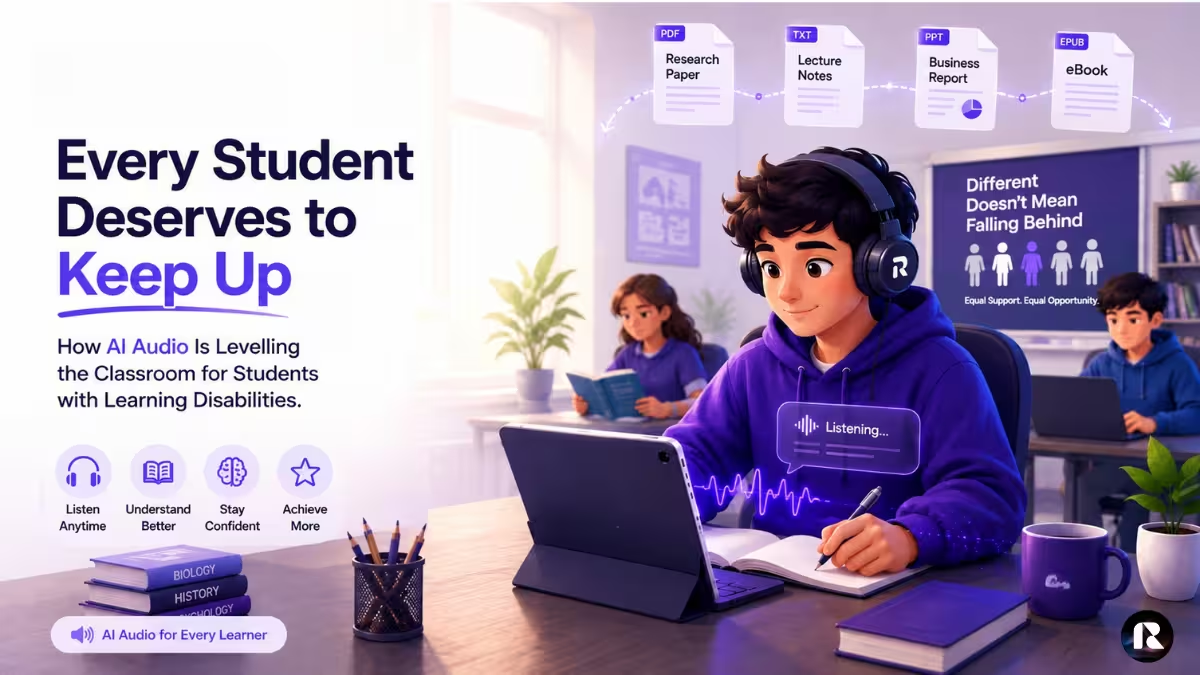
Every Student Deserves to Keep Up: How AI Audio Is Levelling the Classroom for Students with Learning Disabilities
Learning disabilities are not a gap in intelligence — they are a gap in format. Here is what the research says about AI audio in the classroom, and what teachers, parents, and schools can do about it now.
"The gap between what a student knows and what the written format allows them to demonstrate is the defining injustice of learning disabilities in education."
Picture a Year 8 classroom during a history lesson. The teacher has just handed out a two-page reading on the causes of the First World War. The instruction is to read it, then answer five comprehension questions.
For most students, this is a standard task. For the student with dyslexia sitting in the third row, it is something else entirely. She knows this period in history. She watched the documentary. She asked questions in last week's discussion that showed she understood the geopolitical context better than most of her classmates. But the page in front of her is a barrier. The decoding required to extract information she already understands will take her twice as long as everyone else — which means she will answer fewer questions, appear less prepared, and receive a lower mark for content knowledge she actually has.
This is happening in classrooms every day, at scale.
The Scale of What We Are Talking About
Learning disabilities are not rare. They are not edge cases that specialist schools handle. They are present in virtually every classroom in every school in the developed world. The widely quoted figure, from Understood, is that 1 in 5 children in the US have learning and thinking differences such as ADHD or dyslexia — an estimate that is broader than formal diagnosis. The diagnosed rates are lower but still substantial: a 2022 meta-analysis puts the pooled prevalence of developmental dyslexia at 7.10% of primary school children, and the CDC reports that 11.7% of US children aged 3 to 17 have a current ADHD diagnosis. Either way, most of these difficulties land on reading, writing and mathematics — the foundational academic skills essential for educational success.
| Learning Disability | Estimated Prevalence (children) |
|---|---|
| Dyslexia | About 5–17.5%, depending on how it is defined |
| ADHD | 11.7% of US children aged 3–17 have a current diagnosis (CDC) |
| Dysgraphia | Estimates vary widely by definition |
| Dyscalculia | Estimates vary widely by definition |
| Auditory Processing Disorder | Estimates vary widely by definition |
| Language Processing Disorder | Estimates vary widely by definition |
By the numbers
About 7.5 million students aged 3 to 21 received special education services under IDEA in 2022–23, and the National Center for Education Statistics reports that specific learning disabilities were the most common category, at 32 percent. Most tellingly: about two-thirds of school-age students served under IDEA spend 80 percent or more of their school day in general education classes — not in a specialist room, but alongside their peers, with the same worksheets, textbook pages, and written assessments.
That is the gap we are talking about. Not a gap in intelligence. Not a gap in curiosity or capability. A gap in format — between how schools deliver information and how these students can most effectively access it.
The Format Problem: It Is Not About Intelligence
The most important thing to understand about learning disabilities is what they are not. Dyslexia is not low intelligence. It occurs at all levels of intelligence, and it is defined by difficulty that is unexpected relative to a student's other capabilities rather than by a low score on anything. Their challenge is specific: the neurological process of decoding written symbols into language. A student with dyslexia who listens to a passage can often understand it as well as or better than their peers. The same student reading the passage silently takes significantly longer, makes errors, and expends cognitive resources on decoding that their peers direct toward comprehension.
ADHD does not indicate low capability either. Students with ADHD frequently demonstrate exceptional creativity, pattern recognition, and depth of engagement with material they find compelling. Their challenge is sustained attention across a fixed-pace reading task — particularly when the format provides no variation in stimulation and no control over pacing.
Specific learning disabilities are the single largest category served under IDEA, accounting for 32% of the 7.5 million students receiving special education services, and many of those difficulties show up in reading. The skills hardest hit are almost entirely format-dependent. Change the format — remove the reading barrier — and the content becomes accessible. The knowledge can be demonstrated. This is the insight AI audio makes actionable at scale.
What AI Audio Actually Does in the Classroom
Text-to-speech technology converts written text to spoken audio in real time. In educational settings, the application is direct: any text-based material — a worksheet, a textbook chapter, an assignment brief, a study guide, a research article — is converted to audio that the student listens to while following along with synchronised text highlighting.
The result is a dual-modal experience: the student hears the content and sees the text simultaneously. Many students with reading difficulties find that easier to follow, though the research on comprehension gains is more modest: a meta-analysis of 30 studies found a small overall benefit, and no reliable one when readers set their own pace. For a student with dyslexia, this removes the decoding burden entirely. For a student with ADHD, audio provides the pacing structure and sensory engagement that silent reading lacks — the ability to pause and rewind gives them control over their focus without the stigma of falling behind.
For Dyslexia
Removes the decoding burden and lets the student engage directly with the concepts, not the barrier standing in front of them.
For ADHD
The voice keeps the student anchored to the material. Highlighted text prevents the eye-wandering that derails silent reading sessions.
For Auditory Processing Disorder
Combining audio with visual text support creates redundancy — two channels delivering the same information.
While not classified as a learning disability, the format barrier for English Language Learners (ELL) is real and significant. Hearing text read aloud while following along provides pronunciation modelling, vocabulary support in context, and redundancy for students whose reading speed in English does not yet match their comprehension capacity.
What the Research Says
The evidence base for AI-assisted learning with students with disabilities is growing. A systematic review and meta-analysis of 29 (quasi-)experimental studies found a medium average effect (g = 0.588) for AI-based interventions with students with disabilities. That category covers robots, computer software and virtual-reality systems, so it is broader than text-to-speech. For text-to-speech specifically, the effect is smaller and more conditional than that — our evidence-based guide to text-to-speech for dyslexia and ADHD sets out the measured effect sizes, and the conditions under which they drop to zero.
None of the factors the review examined (participant, AI, intervention and methodology characteristics) significantly changed the average effect, and its authors call for more rigorous research.
That is a reason for caution, and a practical point: audio tools should be part of a deliberate classroom approach, not simply handed to a student and left to run. The argument for schools adopting them is not that they replace teacher effort, but that they can reduce the time spent adapting materials and redirect it toward where human skill is irreplaceable.
How It Works for Different Learners
Dyslexia's core challenge is phonological processing — connecting written symbols to sounds. TTS does not require that connection; it makes the sounds directly available. A student with dyslexia using ReadLoudly to listen to a chapter while the text is highlighted experiences correct pronunciation of words they might otherwise misread, full comprehension without the cognitive cost of decoding, and the ability to pause, rewind, and re-hear any section that needs clarification. The chapter no longer takes them twice as long — and the mark they receive reflects what they actually understand.
ADHD presents reading difficulties rooted in attention regulation rather than decoding. Audio introduces the variation that sustains attention: dual-channel engagement is inherently more stimulating than silent reading, and speed control lets a student increase pace for familiar material and slow down for dense passages — maintaining a sense of forward movement that ADHD brains respond to better than fixed-pace reading.
Auditory Processing Disorder affects how the brain processes incoming audio — these students frequently struggle to extract speech in noisy environments. In a quiet, controlled listening session with headphones, the challenges of the noisy classroom are removed, and the text on screen provides a redundant visual channel that compensates for any gaps.
For Teachers: Practical Classroom Implementation
Identify which students would benefit most
Start with students who have existing IEPs or 504 plans for reading-related learning disabilities, then expand to students who consistently struggle with reading-based tasks regardless of formal diagnosis.
Introduce ReadLoudly as a standard tool, not a remedial one
Frame audio reading as a learning option available to everyone. When the whole class is given the option to listen while following along, the stigma of using assistive technology disappears — students who need it use it, others may use it by preference.
Upload materials before class
Upload the day's reading material — worksheet PDFs, textbook pages, assignment briefs — to ReadLoudly before the lesson. The upload takes under two minutes.
Teach students to use speed control deliberately
Model 0.9x–1.0x for new or complex material, 1.25x–1.5x for review or familiar content. Students who learn to use speed as a comprehension tool develop metacognitive awareness that transfers beyond the tool.
Combine with active capture
Pair audio reading with a simple note-taking protocol — one key idea per paragraph, in the student's own words. Listening plus summarising in your own words usually works better than listening passively.
Assistive technology is best treated as a scaffold alongside teaching, not a substitute for it. ReadLoudly works best when teachers build it into the lesson structure rather than leaving students to use it independently without guidance.
For Parents: Using ReadLoudly at Home
The classroom is not the only place where the format barrier operates. Homework, independent reading, exam preparation — all of it presents the same challenge at home that school materials present in class.
For homework
Upload assignment readings, study guides, and textbook chapters before your child sits down to work. Let them listen once for comprehension before tackling written tasks — this often produces a significant reduction in homework-related frustration and the time the work takes.
For exam revision
Study notes, revision guides, and past paper questions can all be converted to audio. Listening during the week before an exam — not as the sole strategy but as an additional pass — reinforces retention through a different sensory channel.
Books assigned for school that exist as PDFs or ebooks can be uploaded directly, giving your child access to grade-level literature without the decoding barrier derailing the experience.
One practical note: introduce one tool, embed it for two to four weeks, then add the second. Slow sequential adoption produces faster long-term outcomes than rapid multi-tool rollout — start with ReadLoudly for homework reading, and once that is a habit, expand to exam revision.
For School Decision-Makers: The Institutional Case
The equity argument
Universal Design for Learning holds that materials designed to be accessible to students with disabilities are better for all students — audio-accompanied reading supports diagnosed students, struggling readers, ELL students, and anyone whose reading pace doesn't match their comprehension.
The inclusion argument
Inclusion without accessible materials is not inclusion — it is physical proximity without equal access. AI audio makes the same materials genuinely accessible, not just physically present.
The dropout prevention argument
When every reading task is a struggle, students can disengage from school altogether. Tools that remove the format barrier at the point of learning support the long-term relationship students have with education, not just individual lesson outcomes.
The cost argument
ReadLoudly's free plan reads documents aloud using the device's own voices, with no credits to manage. Paid plans start at $5 per month and add whole-document processing and ad-free listening.
The teacher workload argument
Rather than preparing separate adapted materials for students with IEPs, teachers upload a single document that is accessible to all students in both text and audio formats — the differentiation happens at the tool level, not the preparation level.
ReadLoudly tools: Text to Speech · PDF Reader · Ebook Reader
The Classroom Every Student Deserves
By Understood's estimate, one in five students has a learning or thinking difference. Most students receiving special education spend 80 percent or more of their school day in that same general classroom, with the same materials as everyone else.
AI audio does not lower the bar. It removes a barrier that was never a fair measure of anything in the first place — giving every student an equal opportunity to demonstrate what they know.
Try ReadLoudly Free at ReadLoudly.com