
Reading Gets Harder as We Age — Here's How Audio Is Giving Older Adults Their Books Back
Millions of lifelong readers find, somewhere between their forties and their eighties, that reading has gradually become difficult, then tiring, then something they quietly avoid. This is about what is happening — and what opens the door back.
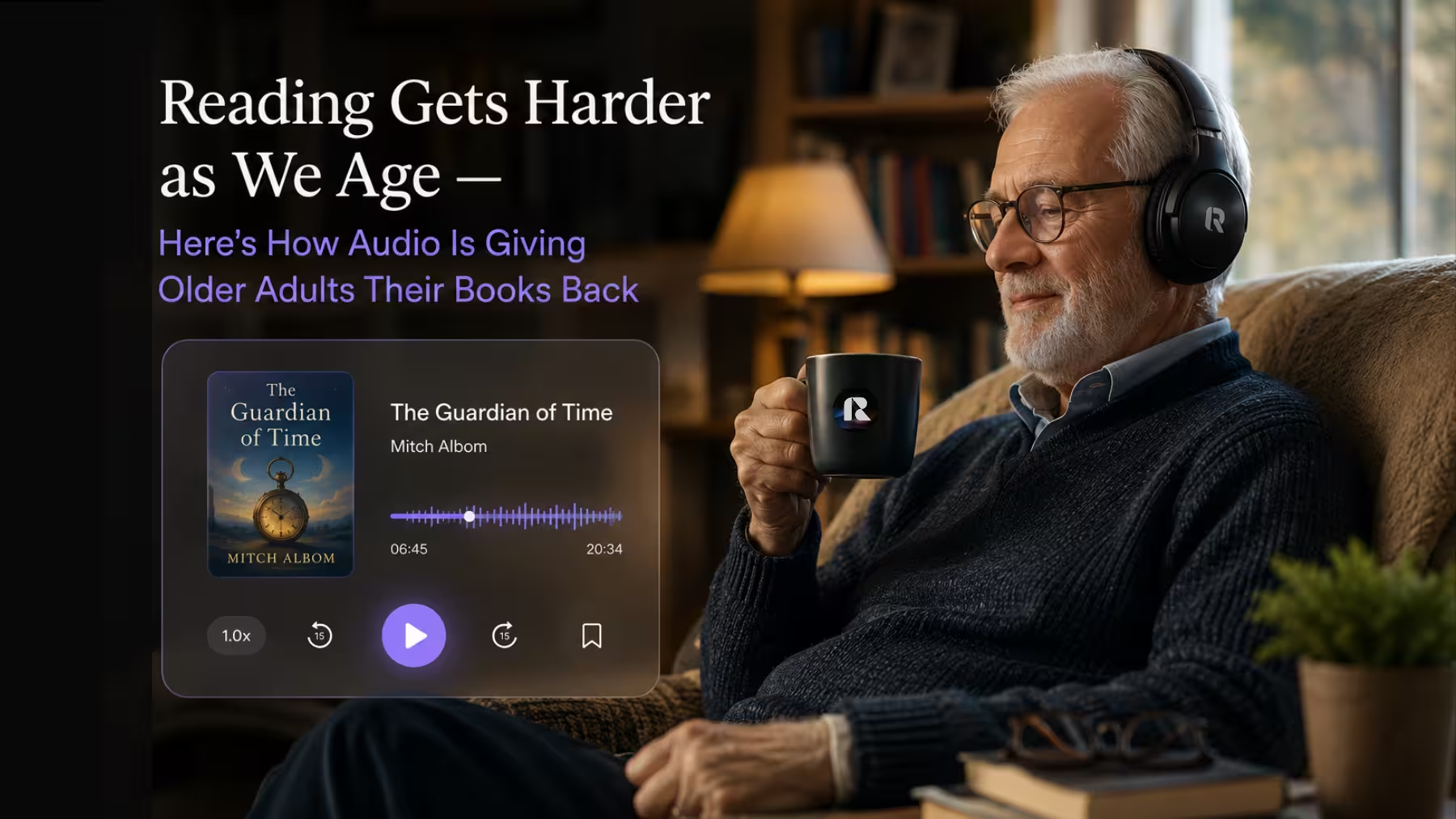
There is a book on the nightstand. You have owned it for three months. You bought it because the review described it as exactly the kind of story you love — the kind you used to read in a single long weekend, cup of tea in hand, curtains drawn against the afternoon, completely lost in someone else's world.
You have read fourteen pages.
Not because the book is bad. Not because you are no longer interested. Because somewhere in the last few years, reading became work. The print seems smaller than it used to be. The light never quite right. Your eyes tire faster than your mind does. You put the book down meaning to return to it, and weeks pass.
This is one of aging's quietest losses — and one of its most common. Millions of people who spent decades as devoted readers find, somewhere between their forties and their eighties, that the activity that gave them so much pleasure has gradually become difficult, then tiring, then something they quietly avoid.
This blog is about what is happening to your eyes, why it matters more than most people acknowledge, and how a technology you might not have tried yet is giving lifelong readers their books — and their reading selves — back.
What Is Actually Happening to Your Eyes
Vision changes with age are not a sign of illness or failure. They are as universal as grey hair — the predictable result of decades of use on a remarkably complex organ.
The most common change is called presbyopia, and it affects nearly everyone.
By the numbers
Presbyopia affects approximately 1.8 billion people worldwide — about 25% of the global population. In the United States, it affects 83–89% of adults aged 45 and older, an estimated 128–139 million Americans. This number is projected to reach 2.1 billion by 2030.
In middle age, the lens of the eye becomes less flexible and less able to thicken — and thus less able to focus on nearby objects. The result is the familiar experience of holding a menu a little further away than you used to, needing more light to read comfortably in the evening, or finding that your eyes tire during extended reading sessions in a way they never did at forty.
Beyond presbyopia, three other conditions are common in older age:
Age-Related Macular Degeneration (AMD)
The leading cause of age-related vision loss in the United States, affecting over 11 million people. AMD affects central vision — the sharp, direct focus needed for reading — making print blurry, distorted, or difficult to track across a line.
Cataracts
As the eye's natural lens ages, proteins accumulate, causing it to become cloudy. Cataracts develop gradually, often without early symptoms. As they progress, they cause blurry vision and increased sensitivity to glare — making reading under artificial light uncomfortable for extended periods.
Reduced Contrast Sensitivity
The ability to distinguish between shades close in tone — including dark text on a light background — diminishes with age. Even with corrected vision, the contrast that makes text readable feels flatter and less defined than it used to.
Presbyopia
The most universal change. The eye's lens stiffens with age, making close focus progressively harder. Nearly everyone over 45 is affected. It is not illness — it is an inevitability. But its impact on reading is real and cumulative.
Research suggests that as many as one in three elderly persons has some form of vision-reducing eye disease. None of this is rare. All of it directly affects reading.
The Loss Nobody Talks About Enough
Here is the part that matters most, and the part that the medical conversation around age-related vision change tends to understate:
For a lifelong reader, losing the ability to read comfortably is not just an inconvenience. It is a loss of identity.
"Many older adults experience vision loss, which can make reading printed books difficult, and losing the ability to read can therefore feel like losing an important part of oneself."
Think about what reading has been over a lifetime. It is the thing you did on childhood Saturday mornings before the world was awake. The escape during difficult decades. The way you processed grief, expanded your thinking, kept company with minds you admired. The novels that felt like personal conversations. The non-fiction that changed how you saw something. The habit that was always there, always available, always yours.
Reading connects older adults with their memories, their sense of self, their loved ones, and the world at large. Well-chosen reading material lessens feelings of boredom, depression, restlessness, and anxiety.
When that activity becomes difficult, the loss runs deeper than the activity itself. Research confirms what anyone who has experienced it already knows:
32–33%
of patients meet criteria for depression within six months following an AMD diagnosis
1 in 4
adults with vision loss experiences anxiety or depression
1 in 3
elderly persons has some form of vision-reducing eye disease that directly impacts reading
The book on the nightstand is not just a book. It is a reminder of something that used to be easy and now is not. And the quiet grief of that — the way it rarely gets named for what it is — is real and worth acknowledging before we talk about any solution.
There Is a Way to Keep Reading
The solution is not to make your peace with not reading. The solution is to change the way reading reaches you.
Your eyes may have changed. Your love of stories, ideas, and language has not. And the words themselves — the books, the articles, the memoirs, the histories, the novels — they are all still there. What has changed is only the format through which they need to travel to reach you.
Audio is that format.
Older adults who initially struggled with unfamiliar devices or grieved the loss of traditional reading, over time developed new skills and routines around listening to books. This transition — from reading with your eyes to reading with your ears — is not a lesser version of reading. Research on language comprehension confirms that the same core brain networks that process written text also process spoken language. A story heard is a story understood. A biography listened to is a biography absorbed. The ideas land. The characters develop. The ending still matters.
What is different is not the reading. What is different is that your eyes get to rest.
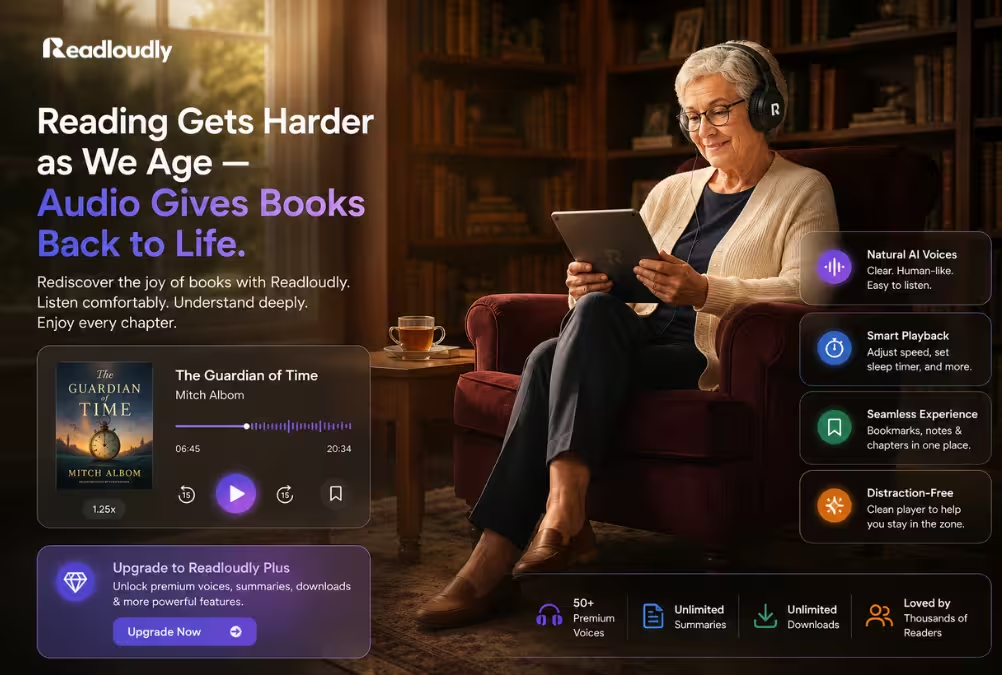
Why Text-to-Speech Is Different From Audiobooks — And Why It Matters
Audiobooks have existed for decades and they are wonderful for novels and popular non-fiction. But they have a fundamental limitation: they only exist for books that a publisher decided to record. Most books have no audiobook version. And almost nothing else you might want to read — a letter from your doctor, an article your grandchild sent you, a chapter from a book your book club chose, a long email from a family member, a newspaper column — exists as an audiobook.
Audiobooks
- Great for bestsellers and popular fiction
- Professional narrators add life to stories
- Only published if a publisher decided to record it
- Letters, articles, newsletters, emails — unavailable
Text-to-Speech (ReadLoudly)
- Converts any written text to audio, on demand
- Doctor's letters, family emails, club newsletters, articles
- 1,200+ voices — find the one that feels comfortable
- Speed fully adjustable from 0.5× to 3×
Text-to-speech restores access to all of it — not just the novels that made it to a recording studio, but everything written.
How ReadLoudly Works — Simply Explained
ReadLoudly is a text-to-speech platform built for exactly this: taking any document you upload and reading it aloud to you in a clear, natural voice.
You do not need to be technically skilled to use it. The process is four steps:
Choose your voice
Select from over 1,200 AI voices — different accents, different paces, different tones. The right voice for sustained listening is a personal preference, and with that many options, most people find one that feels genuinely comfortable within a few minutes.
Set your speed
ReadLoudly plays audio from 0.5× (very slow and clear) to 3×. For most older adults beginning with audio reading, 0.8× or 0.9× — slightly slower than normal speech — is a comfortable starting point. There is no rush. The speed is entirely yours to control. This matters more with age than the advice usually admits: in a study of roughly 1,024 participants, younger adults' comprehension held steady at 0.75×, 1× and 2×, while older adults' comprehension declined as the speed rose (Murphy, Hoover & Castel, 2023). The research on listening speed, and on what text-to-speech does and does not do, is worth a read before you push the slider up.
Listen
The text is highlighted on screen as it is read aloud, so you can follow along visually if you choose — or simply close your eyes, lean back, and listen. Pick up where you left off at any time. Your position is saved automatically.
That is the whole process. Upload, choose, listen. The book that has been sitting on your nightstand for three months can be uploaded and playing in under two minutes.
A Practical Guide to Getting Started
Start with something short
Before you upload your most anticipated book, start with a short article or a few pages of something familiar. This gives you a chance to find the voice you like and the speed that feels natural without the stakes of a long commitment.
Find your voice
Listen to several voices before committing. Some people prefer a calm, measured voice for non-fiction. Some prefer a warmer, more conversational tone for novels. Some find certain accents easier to follow than others. Browse the voice options — this five minutes is worth it.
Choose your listening position
Some older adults find that sitting in a comfortable chair with eyes closed is the most relaxing way to listen. Others prefer following along with the text highlighted on screen, which can help maintain focus and makes it easier to find your place if you drift. Try both.
Build a listening habit around an existing routine
The easiest way to make audio reading a regular part of your day is to attach it to something you already do. Morning tea or coffee. An afternoon rest period. An evening wind-down. Fifteen to twenty minutes of listening during a routine you already have builds the habit quickly and naturally.
Use offline mode for uninterrupted listening
If you upgrade to ReadLoudly Core or above, your books can be downloaded for offline listening — no internet connection needed. This is particularly useful for listening in a garden, a bedroom, or anywhere without a reliable connection.
If You Are Reading This For Someone You Love
Many people who find this post are not the older adult themselves — they are the adult child, the grandchild, the spouse, the friend who has watched someone they love quietly stop reading.
If that is you, here is what to know.
The invitation to try audio reading lands very differently depending on how it is offered. For someone who identifies deeply as a reader, the suggestion that they "switch to audiobooks" can feel like being told to give up — like the reading life is over and this is the consolation prize. That is not the truth, and the way you frame it matters.
How to frame it
Avoid
"You should try audiobooks instead of reading now."
Works better
"I found something that might let you keep reading even when your eyes are tired."
Offer to set it up with them the first time, not for them. Sitting together and finding a voice they like, uploading the first book, listening to the first few paragraphs — doing it alongside someone they trust removes the barrier of unfamiliar technology and makes the first experience feel connected rather than solitary.
Losing vision in older age can feel like losing a piece of your identity. The reader who can no longer drive to the library, read the newspaper over coffee, or see a grandchild's face clearly is grieving real losses. Frustration, anger, and sadness are not signs of weakness. They are the natural response to a hard change.
Audio reading does not erase that loss. But it does open a door that many people assumed had closed.
What Changes When Audio Reading Becomes a Habit
Older adults who make the transition to audio reading consistently report one thing above everything else: they are reading again.
Not as a compensatory activity. Not as a lesser substitute. Actually reading — following stories, finishing books, keeping up with ideas and events, maintaining the conversational common ground with friends and family that a life of reading produces.
The book club conversation they can participate in. The novel the grandchildren are also reading. The biography of a figure they have wanted to understand for years. The newspaper column from the writer they have followed for decades.
What the research says about reading for pleasure:
- Being absorbed in a captivating story reduces stress and induces feelings of relaxation
- Reading contributes to cognitive, emotional, and social well-being
- These benefits do not require eyes. They require ears, attention, and the right tool.
The Book Is Still There
The story has not changed. The ideas are still worth engaging with. The writer's voice — the one you have loved across a shelf of their books — is still doing its work on every page.
What changed is the format. And format is something technology can fix.
The book on the nightstand does not have to stay there. Upload it tonight. Find a voice you like. Listen to the first chapter with a cup of tea in your hand, the way reading always was — comfortable, unhurried, yours.
Start Reading Again — Free