
Your Inbox Is Lying to You: How to Actually Read Every Newsletter You Subscribe To
The average professional subscribes to 25+ newsletters and reads only 21% of them. Your inbox treats a critical business update the same as a 4,000-word essay — and your brain loses every time. Here's how to fix that.
"The modern inbox has become a to-do list that anyone in the world can write on without your permission."
We have all been there: the Sunday morning ritual of hitting "Archive All" or, worse, watching the unread count climb into the quadruple digits. Your inbox is a graveyard of good intentions. Every time you subscribe to a new newsletter, you make a micro-promise to your future self — a promise that rarely gets kept.
The "lying" nature of your inbox stems from its architecture. It treats a critical business update the same way it treats a 4,000-word deep-dive on the history of typography. By flattening all information into a chronological list, your brain loses the ability to prioritize deep reading over urgent reactions. The result: you open 21% of what arrives, archive the rest, and feel vaguely guilty about the gap for the rest of the week.
The fix does not require more willpower or a better email client. It requires moving your newsletters out of an interface designed for triage and into one designed for listening. Here is exactly how to do it.
The Scale of the Problem
| Metric | Number | What It Means |
|---|---|---|
| Average newsletter subscriptions | 25+ | Per professional subscriber |
| Daily emails competing for attention | 117 | Including newsletters, work, notifications |
| Newsletter open rate (industry average) | 21% | 79% goes unread every single week |
| Annual email list decay | 22.5% | One in four subscribers disengages within 12 months |
That 21% open rate is not a personal failing — it is a structural problem. The inbox was never designed to hold long-form content waiting for deep reading. It was designed for rapid triage of short messages. Putting newsletters in an inbox and expecting yourself to read them carefully is like filing your novels in the kitchen junk drawer and expecting to find a quiet evening to read.
Why Your Inbox Is a Broken Reading System
The Timing Problem
Newsletters arrive when the sender wants to send them — not when you are in the right headspace to consume them. A long-form essay arriving at 7 am competes with your urgent morning email scan, and loses every time.
The Attention Competition Problem
Your reading material is sandwiched between invoices, meeting requests, and urgent notifications. The "managing" brain always wins against the "reading" brain because triage is faster and provides a quicker hit of completion.
The "I'll Read It Later" Problem
The archive button is the easiest way to clear cognitive debt without actually learning anything. Archiving a newsletter feels like completing a task. It is not. It is deferring a promise to a future version of you who is no more likely to keep it than the current one.
The Environment Problem
Email clients are designed for triage and quick replies — not for the immersive focus required for deep reading. The interface itself is hostile to the mode of thinking that long-form newsletters demand.
The Mismatch That Explains Everything
"Newsletters are written to be read. Your inbox is designed to be managed."
Managing is about triage, deletion, and archiving. Reading is about absorption, reflection, and synthesis. When you try to do both in the same interface, the "managing" brain always wins because it is faster and provides a quicker sense of progress.
To truly read, you must remove the manage buttons from your field of vision. And the most practical way to do that is to remove your newsletters from the inbox entirely — converting them into audio before they ever compete with your email scan.
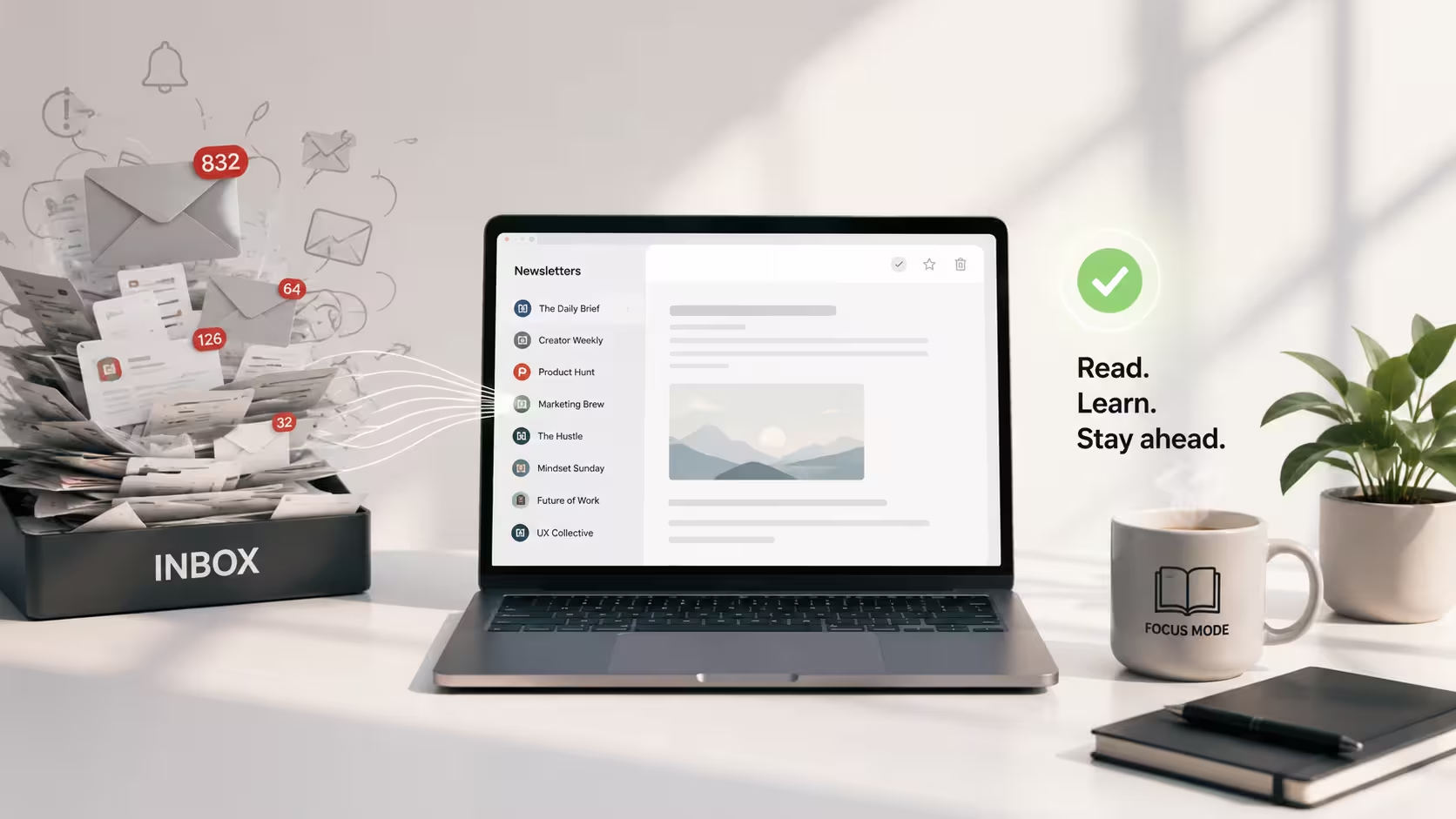
The Fix: Turn Your Newsletters Into Audio
The inbox approach
Newsletter arrives. You see the subject line during email triage. You think "I should read this later." You archive it or leave it unread. You never return to it. Three months later you unsubscribe because you feel guilty every time you see it.
The audio approach
Newsletter arrives. You paste it into ReadLoudly's Text to Speech or forward it to your reading queue. During your morning commute, you listen at 1.25x. By the time you arrive at work, you have consumed what you subscribed to. The newsletter kept its promise. So did you.
The math of audio
10 newsletters (~15,000 words) = approximately 50 minutes of listening at 1.25x speed. The average professional commute is 27 minutes each way — 54 minutes daily. Your backlog clears itself in one day, without touching your desk time.
The 4-Step Newsletter Audio System
Triage Your Subscriptions Into Three Tiers
Before converting anything to audio, do a one-time audit of everything you currently receive. Assign every newsletter to one of three tiers.
Tier 1: Essential
High-value insights you never want to miss. Send these directly to your audio queue. These are your must-listens — the reason you subscribed.
Tier 2: Occasional
Good to know but not vital. Keep in a separate folder for monthly batch listening. One session covers a month of these.
Tier 3: Noise
Anything you have not opened in 30 days. Unsubscribe immediately. The fear of missing out is almost always a lie.
Key discipline: most inboxes have twice as many Tier 3 newsletters as Tier 1. The audit is not about adding more audio — it is about ruthlessly removing what you were never going to read anyway.
Convert on Arrival, Not on Intention
Do not wait until you are ready to read to start the conversion. The "I'll convert it when I need it" approach fails for the same reason the inbox approach fails — intention and follow-through are not the same thing.
- When a Tier 1 newsletter arrives, paste it into ReadLoudly Text to Speech or upload it to the PDF Reader immediately
- Total time to queue a newsletter: under 90 seconds
- The audio sits ready in your library — no friction at commute time
- If you use Notes to Audio, you can also capture your own reaction notes and convert those too
Listen During the Right Dead-Time Window
Different types of newsletters benefit from different listening contexts — and matching content to context improves retention. For more on this, see our guide to increasing reading efficiency.
| Context | Best Newsletter Type | Why |
|---|---|---|
| Commute | Long-form analytical essays | Uninterrupted focus; brain is alert and not fatigued |
| Gym | Industry news and roundups | High-energy updates that don't require complex note-taking |
| Morning walk | Creative commentary and ideas | Low-intensity movement aids reflection and synthesis |
Capture What Matters
Listening is only half the battle. To turn information into a genuine knowledge asset, you need a capture system. For the full framework, see our guide on improving reading retention.
- Use voice-to-text notes immediately after a powerful segment — speak your reaction while it is fresh
- Sync your ReadLoudly highlights to Notion or Obsidian for a searchable knowledge base
- Review your weekly audio notes every Sunday morning — 15 minutes resurfaces the best of what you heard
Newsletters That Reward Audio Most
Not every newsletter belongs in your audio queue. The format of the content matters as much as the topic.
Excellent as audio
- ✓ Analytical essays and long-form commentary
- ✓ Industry analysis and trend breakdowns
- ✓ Narrative writing and stories
- ✓ Roundups with editorial commentary
- ✓ In-depth Q&As and interviews
Better skimmed on screen
- ✗ Link-only digests with no commentary
- ✗ Content heavy on charts and data tables
- ✗ Promotional and sales content
- ✗ Visual-first portfolios and galleries
The rule of thumb: if the newsletter is primarily an argument or a narrative, it belongs in your audio queue. If it is primarily a visual artifact or a list of links, it belongs in your "skim" tier. Most newsletters from serious writers fall firmly in the first category — which means most of your backlog is audio-ready right now.
What Changes When You Actually Read What You Subscribe To
The guilt disappears
Your inbox transforms from a pile of unread debt into a curated queue of content you have already consumed. The unread count stops mattering because the listening already happened.
Your thinking changes
Regularly engaging with the writers you follow develops a deeper intellectual relationship with their ideas. You start forming opinions, noticing contradictions, and building on arguments over time.
You become more interesting
Fresh ideas from your Tier 1 writers surface naturally in your professional and social conversations. The person who actually reads what they subscribe to has a distinctive intellectual richness that is immediately noticeable.
The newsletter math, made concrete
Your commute is 25 minutes. The newsletter you have been meaning to read for two weeks is 8 minutes at 1.25x. Paste it into ReadLoudly before you leave the house. You are already ahead. Explore the full ReadLoudly toolkit — PDF Reader, Text to Speech, and Notes to Audio — for everything that needs to be heard.
Curing the inbox lie is not about productivity hacks. It is about respecting your own attention. When you control the pipeline of information — choosing what enters, when you consume it, and in what format — you shift from reactive consumer to proactive learner. Start today: triage your subscriptions into three tiers, unsubscribe from Tier 3, and convert your first Tier 1 newsletter to audio before tomorrow's commute. Your future self will thank you for the silence.