
How Top Creators Research 10× Faster: The Podcaster's Complete Audio-First Content System
The average episode takes 3–5 hours of research before a single word is recorded. Top creators cut that screen time by 60–80% with one shift: converting all research to audio and consuming it during dead time.
"The creators who consistently publish deep, well-researched content at high frequency are not working more hours. They rebuilt their research around one core insight."
The average podcast episode takes between 3 and 5 hours of research before a single word is recorded.
For interview shows, that number climbs higher. Identifying and vetting a guest, reading their book or work, listening to their previous interviews, preparing genuinely insightful questions that go beyond what every other host has already asked — for a well-prepared interview episode, pre-production can reasonably take three to five hours before recording begins.
That research bottleneck is the number one reason talented creators publish inconsistently, burn out, or produce episodes that feel shallow and unprepared. Not a lack of ideas. Not bad equipment. Research time.
And almost all of it is being done wrong.
The creators who consistently publish deep, well-researched content at high frequency are not working more hours. They have rebuilt their research around one core insight: almost everything you need to research can be listened to rather than read. Which means it can happen during the hours you already have — commutes, gym sessions, walks, meals — rather than competing for the focused desk time you need for actual creation.
This is the audio-first content research system. Here is how it works, step by step.
What Is an Audio-First Research System — and Why Does It Matter in 2026?
Traditional research
Open a browser tab. Find five articles on your episode topic. Add a book to your reading list. Download a PDF transcript. Then block three hours on your calendar to read all of it before your next recording session — time that competes with writing, editing, pitching sponsors, and managing social media. It almost never happens completely.
Audio-first research
Convert those same articles, PDFs, transcripts, and book chapters to audio using ReadLoudly's PDF Reader before you get in the car or put your headphones in at the gym. The research happens during the time you were spending on commuting and exercise regardless. Your focused desk hours remain protected for creation.
The result: traditional wisdom suggests spending ten hours a week researching, recording, editing, and marketing a single episode. An audio-first researcher reduces the screen-based portion of that by 60–80%, freeing focused hours for higher-value creative work.
The Research Time Problem: By the Numbers
Before building the system, it helps to understand exactly where the time goes.
| Research Task | Traditional (Screen) | Audio-First | Time Saved |
|---|---|---|---|
| Reading 3–5 background articles | 35–50 min | 20–30 min (1.5x) | 15–20 min |
| Reading a guest's book chapter | 40–60 min | 22–35 min (1.5x) | 18–25 min |
| Reviewing previous guest interviews | 45–75 min | 25–45 min (1.25x) | 20–30 min |
| Reading a research report or study | 30–45 min | 18–25 min (1.5x) | 12–20 min |
| Reviewing listener Q&A / feedback | 15–25 min | 8–14 min (1.5x) | 7–11 min |
| Total per interview episode | 165–255 min | 93–149 min | 72–106 min |
That is over an hour saved per episode on research alone — purely from speed. But the more important gain is different: with an audio-first system, none of those hours need to come from your screen time at all. They happen during your commute. During your run. While you make dinner.
That is not 10% more efficient. That is a fundamentally different relationship with your research capacity.
The 5-Step Audio-First Research System for Podcasters
Build Your Research Queue Before the Week Starts
Every Monday morning — or Sunday evening — spend 15 minutes building that week's research queue. This is a curated list of everything you need to consume before your next episode records.
Solo topic episode queue
- 3–5 articles from trusted publications on the topic
- One longer-form essay or report from a field expert
- Listener questions relevant to the topic
- Your previous notes on adjacent topics
Guest interview queue
- Guest's most recent book or report (key chapters)
- 2–3 of their most cited interviews or talks
- Their most recent published writing
- Any controversy or debate in their field
Key discipline: Build the queue before research begins. Creators who research ad hoc spend enormous time deciding what to read next rather than consuming it.
Convert Everything to Audio
This is the pivot point of the system. Once your research queue is built, convert every text-based item to audio. Articles, PDFs, book chapters, downloaded transcripts, reports — all of it.
- Upload a PDF of your guest's book chapter to ReadLoudly's PDF Reader — converted to natural audio in under a minute
- Paste any article URL or copied text into the Text to Speech tool for instant audio
- Open downloaded transcripts and reports directly — ReadLoudly supports PDF, DOCX, EPUB, and more
Key tip: Name your audio files clearly before upload — "Guest Name — Book Title — Ch3-4" rather than "document-2026-07." When you're listening in the car and want to jump back, clear naming saves minutes of scrolling.
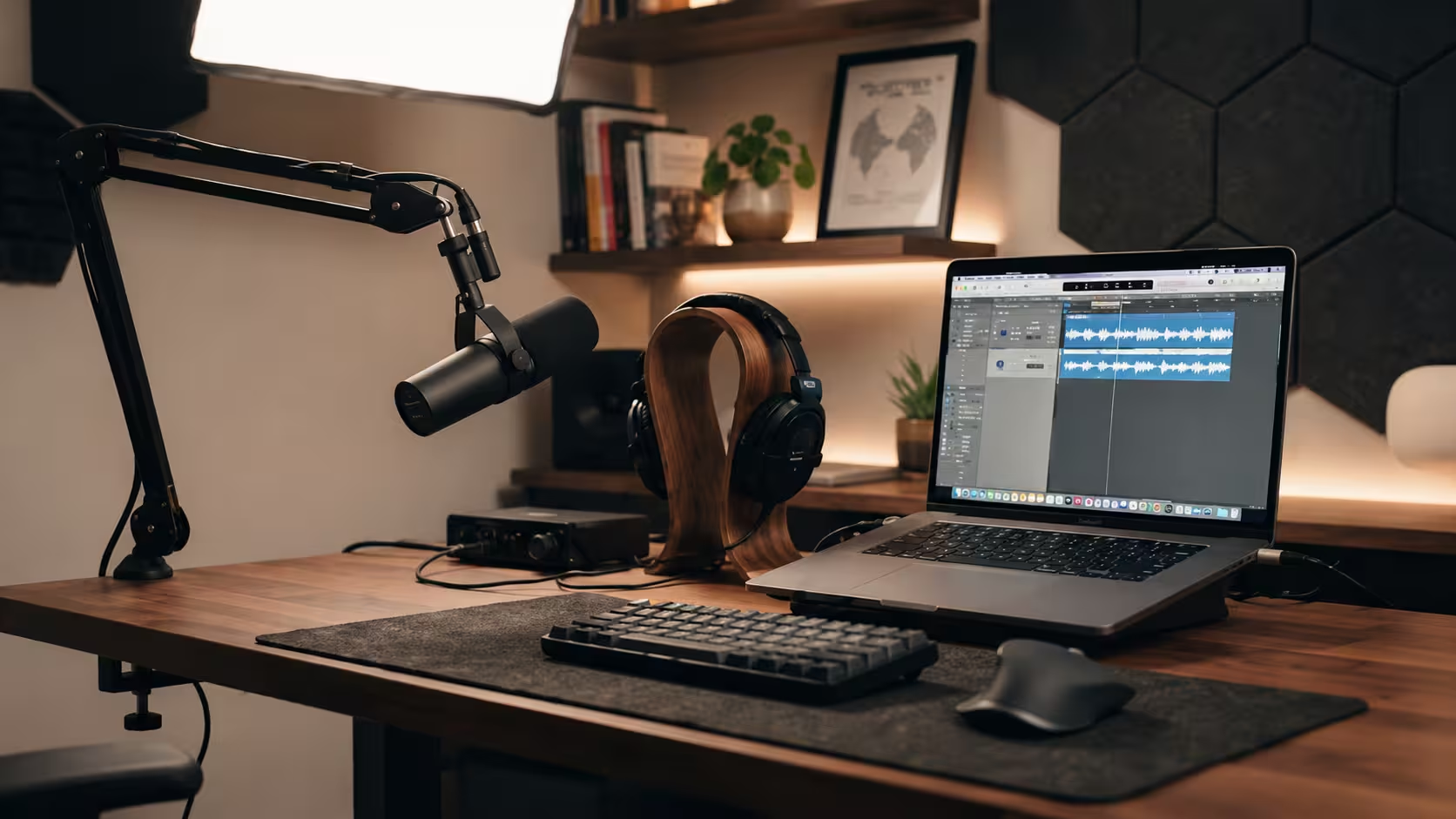
Consume During Dead Time — The Right Way
Not all research deserves the same listening speed. Calibrate your playback to match the value of the content — and read about the science behind this in our guide on increasing reading efficiency.
| Content Type | Recommended Speed | Why |
|---|---|---|
| Orientation / background articles | 1.5x – 2x | Establishing landscape, not building precision knowledge |
| Guest's primary work (book, flagship talk) | 1.0x – 1.25x | This is where your best interview questions come from |
| Previous interviews with your guest | 1.5x | Identifying what's already been asked — questions to avoid |
| Data-heavy reports / methodology sections | 0.9x – 1.0x or screen | Audio is not always the right modality for statistics |
The physical separation from your desk matters more than most creators expect. Many creators report better recall from walking research than desk research — consistent with what exercise neuroscience suggests about memory consolidation during movement.
Capture as You Listen
Audio research without a capture system produces one outcome: you arrive at your recording session with a vague feeling of being prepared but no specific recall of what you learned. See our full guide on improving retention from audio for the science behind this.
The discipline: voice memos while you listen. Not written notes — voice memos.
When something lands during your listening session — a quote you want to reference, an angle you want to explore, a question that forms in your mind — pause the audio and speak a 15-second voice memo. "Guest said in her 2024 talk that 70% of creators quit within 18 months — ask why she thinks the failure rate is so high."
At the end of your listening session, those voice memos get transcribed (most phones do this automatically) and become the raw material for your episode outline. The entire pipeline from research to structure can happen without a single extended block of screen time.
Structure the Episode From Your Captured Notes
By the time you sit down at your desk, you have:
- A set of transcribed voice memo notes from your listening sessions
- A clear mental map of your guest's thinking and background
- A list of angles no other host has explored
- The 4–6 questions that will make the interview genuinely interesting
The desk session — which used to be the entire research process plus the outline — is now just the outline. For most creators, this drops from 3–5 hours to 45–90 minutes. That is the 10x claim made concrete: not that each individual task is 10 times faster, but that the system reclaims dead time at a scale that multiplies your effective research capacity across the week.
The Audio-First Listening Stack: Tools That Make It Work
| Tool | Role in System | Cost |
|---|---|---|
| ReadLoudly | Converts all text research to audio — articles, PDFs, transcripts, reports, ebooks, and notes | Free to start |
| Voice Memos (iOS/Android) | Capture insights while listening — replaces written notes during commute | Free (built-in) |
| Otter.ai | Auto-transcribes your voice memos into text for episode outlines | Free (300 min/mo) |
| Notion or Obsidian | Houses episode outlines, guest research, and content archive | Free |
| Snipd or Airr | Captures highlights from podcast audio you listen to for research | Free / paid |
| Readwise | Stores and resurfaces your best research highlights across sources | $7.99/mo |
Total stack cost: free to under $10/month. The return — 3+ hours reclaimed per episode — is significant for a solo creator.
How to Research a Guest in Under 60 Minutes (Audio-First Method)
This is the specific workflow that separates prepared interviewers from forgettable ones.
Queue build
Find the guest's most recent book (download a key chapter as PDF), their most widely shared talk or interview (transcript or audio), and their three most recent published pieces. Upload them all to ReadLoudly immediately. Name each file clearly.
Morning commute or gym session
Listen through the key chapter at 1.0x. Switch to their most widely shared interview at 1.5x — focus on what they've already said extensively so you can ask something different. Drop two or three voice memos as new questions form.
Transcription review
Open your transcribed voice memos. Organise into: "Must ask," "Good if time," and "Skip — they've said this before." That is your interview guide.
Final pre-call listen
Right before the call, play back their key talking point at 1.0x. It warms your context and puts their thinking in your immediate working memory.
Total: under 60 minutes of active effort.
Most of it happened during time you were spending anyway. Your desk session is 45 minutes of structuring — not 3 hours of everything.
What This System Does for Your Content Quality
Research depth shows. Listeners can feel within the first five minutes of an interview whether the host actually read the guest's work or is running on a one-paragraph bio.
The creators who consistently build loyal audiences are not necessarily the most charismatic or the most technically polished. They are the ones who consistently demonstrate that they took the subject seriously enough to prepare. That quality of preparation is what makes guests refer other guests, what makes listeners trust recommendations, and what makes sponsors pay attention.
An audio-first research system does not just make you faster. It raises the ceiling on how deeply you can prepare, because you are no longer constrained by how many screen hours your week contains.
The ceiling before
Research capacity was limited to your available screen hours. Three competing priorities meant something always got cut. The guest preparation suffered. The episode felt thin. The follow-up questions were the ones every other host had already asked.
The ceiling after
Research capacity now includes every commute, every gym session, every walk, every meal eaten alone. The desk hours are protected for the work that actually requires a desk. Preparation depth goes up. Episode quality goes up. The questions nobody else is asking start appearing.
SEO Benefits of Research-Led Content
There is a secondary benefit for content creators who maintain a blog, newsletter, or YouTube channel alongside their podcast: research depth drives search rankings.
Google's Helpful Content system now actively rewards content that demonstrates genuine expertise and research — content that covers a topic more thoroughly than a surface-level pass. Creators who use an audio-first research system consistently consume more material per episode, which translates directly into more specific claims, more accurate data points, more nuanced angles, and better coverage of the topic as a whole.
The creator who listened to six sources before recording produces content that references six perspectives. The one who had time to read two produces content that references two. The difference in depth is detectable — by listeners, by readers, and increasingly by search algorithms.
The system in one paragraph
Build your research queue on Sunday or Monday morning. Upload everything to ReadLoudly before you leave the house. Listen during your commute, your gym session, and your evening walk across the week. Capture insights as voice memos. Transcribe those memos and organise them into an episode outline at your desk in 45 minutes. Record with the preparation of someone who spent 5 hours at a screen — because in terms of content absorbed, you did — while using your screen hours for the creative work that actually moves your show forward.
Ready to start? Upload your next episode's first research article to ReadLoudly and listen on your next commute. Your research queue is waiting. You can also explore Text to Speech for pasting articles directly, Ebook Reader for book chapters, and Notes to Audio for converting your own research captures. The full suite is at ReadLoudly Tools.