
How to Turn a Textbook Chapter (or Your Notes) Into a Podcast You Can Actually Study From
A two-host dialogue about the same content produced learning gains with an effect size of 0.83 over a plain explanation, and listening comprehension matches reading. Here is the six-step tutorial for turning any chapter into an episode, which tone to pick, how fast to play it, and the quiz habit that stops it from being background noise.
"The chapter you did not have time to read fits inside the commute you have every day. It just needs to become something you can listen to."
Turning your notes or a textbook chapter into a podcast takes a few minutes in 2026: upload the file, pick a tone and two voices, choose a length, and an AI writes and voices a conversation between a host and a guest about what is in your document. You get a player, a readable script, and an MP3 you can take anywhere. This tutorial walks through every step, and then through the part most guides skip: how to listen so the material is still there on exam day.
The habit is already in place. 58% of Americans aged 12 and over listened to a podcast in the last month, and 45% in the last week (Edison Research, The Infinite Dial 2026). Among 18-to-29-year-olds, 67% listened to one in the past year, twice the rate of people over 65 (Pew Research Center, September 2025). Students already have the headphones in. The question is whether what comes through them is the chapter.
Key Takeaways
- Two-host dialogue is not a gimmick: in a 364-student physics trial, a dialogue version of the same content produced learning gains with an effect size of 0.83 over a plain explanation of the same material, and listening comprehension matches reading for adult nonfiction (g = 0.07 across 46 studies).
- Six steps in ReadLoudly Study Hub: upload a chapter-sized PDF, DOCX or EPUB, tick Podcast, pick one of four tones, choose two different premium voices and a language, set the length, generate. You get a player, the script, and an MP3 download.
- Speed is nearly free up to 1.5x: UCLA students scored 26 out of 40 at normal speed and 25 at 1.5x immediately after; a week later the gap was three points. A 2025 meta-analysis of 24 studies calls the cost at 1.5x and below small and often not significant.
- Listening alone is not studying. Students who got a podcast instead of the text preferred it right up until the quiz, where they scored worse. Pair every episode with a quiz or a flashcard rep from the same upload.
- Podcast generation is a paid feature on ReadLoudly Core at $5/month, alongside five free study tools from the same upload. Google's Gemini Notebook offers a free Audio Overview with compute-based limits since September 2, 2026; dedicated podcast apps run $11 to $29 a month.
Part of our guide to how to study with AI in 2026. The podcast is the listening half of the document-to-study-set system; the AI quiz generator and flashcard guides cover the retrieval half.
Why a Two-Host Podcast of Your Chapter Works
A conversation about your chapter teaches better than a straight reading of it because the two speakers do the questioning for you. One raises the misconception, the other corrects it; one asks why, the other explains. Overhearing that exchange is closer to being tutored than to being lectured, and the research on it predates AI podcasts by nearly two decades.
In the clearest test, 364 first-year physics students were randomly assigned to one of four online treatments on Newton's laws. The dialogue version produced the largest learning gains, with an effect size of 0.83 compared with a plain exposition of the same material (Muller et al., Journal of Computer Assisted Learning, 2008). Students with the least prior knowledge gained the most.
Two related findings explain why. Learners who overheard a dialogue in which a deep "why" question preceded each explanation outperformed learners who heard the same content as a monologue (Craig et al., Cognition and Instruction, 2006), and pairs who watched recordings of someone else being tutored learned physics problem-solving about as well as the students who were actually tutored (Chi, Roy & Hausmann, Cognitive Science, 2008). A host-and-guest podcast about your chapter is a tutoring dialogue you can overhear on a bus.
And listening itself is not a downgrade. A meta-analysis of 46 studies with 4,687 participants found no reliable overall difference between reading and listening comprehension (g = 0.07), with reading ahead on inferential questions (g = 0.36) and, more modestly, when readers set their own pace (g = 0.13) (Clinton-Lisell, Review of Educational Research, 2022). That inference gap is the one the two-host format is built to narrow: the guest asks the inferential questions out loud.
How to Turn Notes Into a Podcast, Step by Step
The steps below use the Podcast tool in ReadLoudly Study Hub. It is a paid feature, included on ReadLoudly Core, because every line is voiced with premium voices; the quiz, flashcards, tutor, notes and fill-in-the-blanks tools from the same upload are free. Budget a few minutes the first time.
Get one chapter into a text-based file
Export lecture slides or typed notes to PDF or DOCX, or use the chapter's PDF or EPUB. The file needs real, selectable text: scanned or image-only PDFs are rejected at upload, because there is no text to write a script from. Keep it to one chapter or one lecture. The script is written from a compact slice of the document, so a 300-page upload produces an episode about the opening pages, not the whole book.
Upload it and tick Podcast on the configure screen
Open Study Hub, upload the file, and tick Podcast. You can tick Multiple Choice and Flashcards in the same pass; you will want them later, and they come from the same upload without uploading twice.
Pick a tone
Casual Chat, Deep Dive, News Style or Storytelling. The tone changes the script, not just the delivery, so the same chapter sounds different under each one. The next section matches tones to chapter types; when in doubt, Deep Dive for anything you will be examined on.
Choose two different voices and a language
Speaker 1 is the host, Speaker 2 the guest, both from the premium voice library. The app will not generate with the same voice in both roles, so the two sides of the conversation always stay distinct. The episode can be produced in ten languages: English, Spanish, French, German, Arabic, Hindi, Portuguese, Chinese, Turkish and Japanese.
Set the length
Auto sizes the episode to the chapter, roughly three to five minutes. Short gives a two-to-three-minute recap for a chapter you mostly know. Long runs five to eight minutes and leaves room for the examples. Auto is the default and the right pick when you are not sure.
Generate, then take it with you
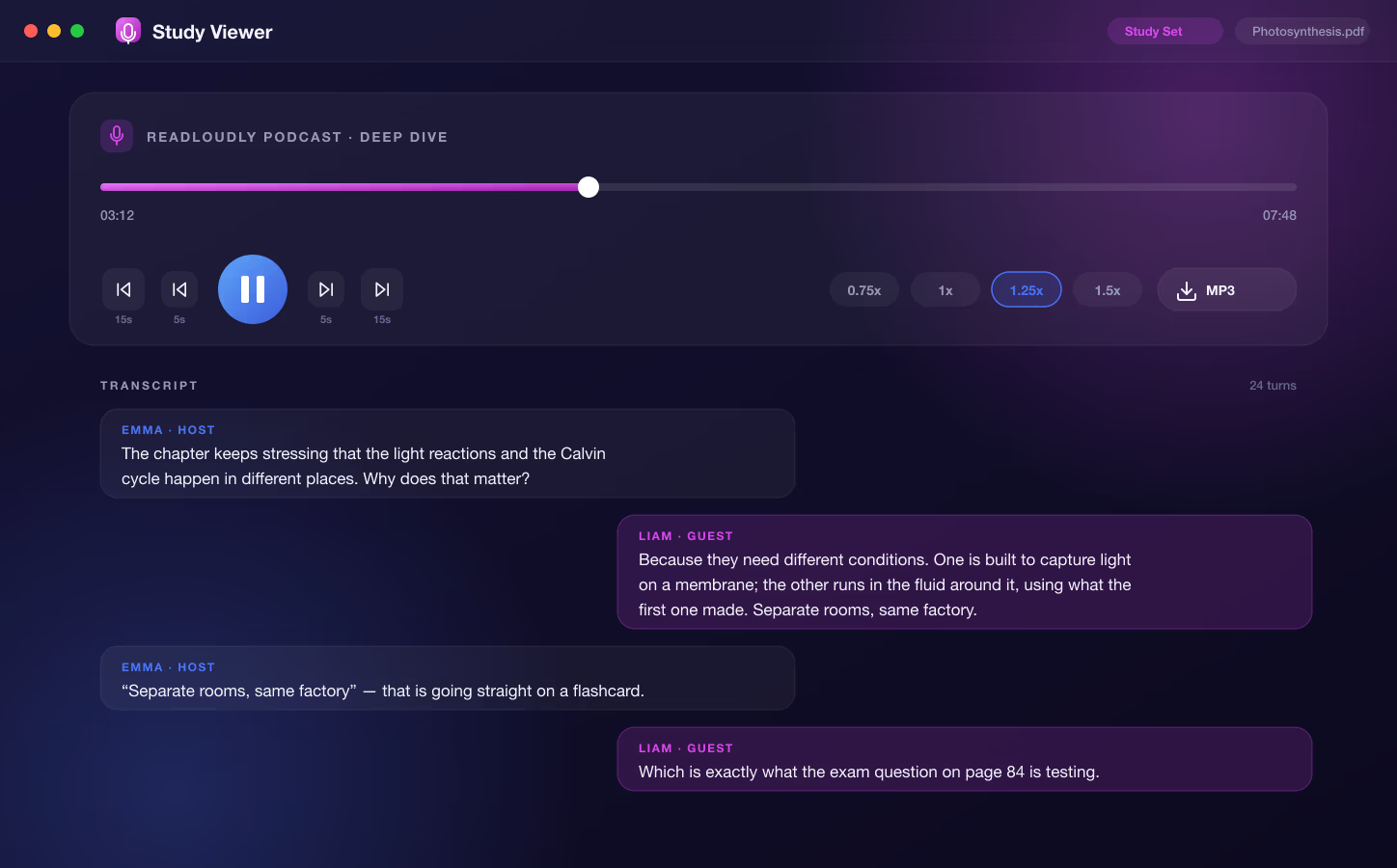
The finished episode opens in a player with the full script underneath as readable text, playback speeds from 0.75x to 1.5x, and an MP3 download button. Save the file to your phone and it plays in any music or podcast app with no connection. Skim the script once against the chapter; if a term or number looks off, open the source page before it reaches your flashcards. The episode also stays inside the study set, next to the quiz and flashcards from the same chapter.
Which Tone for Which Chapter
Match the tone to what the chapter is for, not to your mood. The tone changes what the two speakers choose to dwell on, so the wrong one can produce a pleasant episode that skips the part you will be tested on.
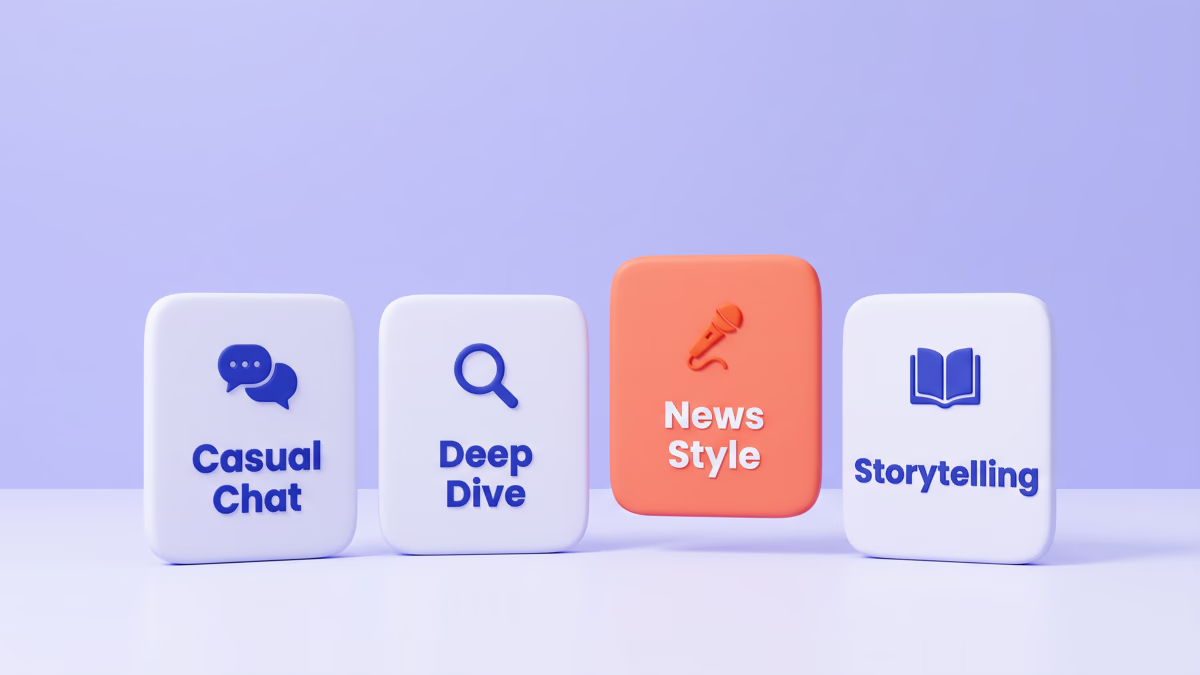
Casual Chat
Friendly and relaxed. Best for a first pass on a chapter you have not read yet, or for a subject you find dry. Lowest intimidation, lightest on detail.
Deep Dive
Thoughtful and analytical. The default for anything examinable: the guest pushes on mechanisms and exceptions, which is where exam questions live. Pair with the Long length for dense chapters.
News Style
Crisp and professional. Good for revision the week before an exam, when you want the key facts stated plainly and fast rather than explored. Works well at 1.5x.
Storytelling
Warm and narrative. Suits history, case studies, literature and anything with a sequence of events or people. Less suited to formula-heavy chapters.
How Fast to Listen
Listen at 1.25x by default and 1.5x for revision. Up to that point the research says you lose almost nothing, and past it you start paying for the saved minutes with the score.
The reference study had 231 UCLA undergraduates watch lecture videos at normal speed, 1.5x, 2x or 2.5x, then sit a 40-question test immediately and again a week later. Immediate scores were 26, 25, 25 and 22 out of 40. A week later they were 24, 21, 21 and 20 (Murphy et al., Applied Cognitive Psychology, 2022, via UCLA Newsroom). The authors put the point where comprehension starts to slide at roughly double speed, around 275 words per minute.
A 2025 meta-analysis of 24 lecture-video studies and 110 effect sizes reached the same conclusion: faster playback can hurt test performance, but the cost is "small (and often non-significant) for speeds 1.5x and slower" (Tharumalingam et al., Educational Psychology Review, 2025). A follow-up across four experiments found comprehension intact at double speed, while noting that audio without visuals is somewhat less forgiving than video (Chen et al., Educational Psychology Review, 2024). Not every study agrees: a trial with 54 medical students found 1.5x scored lower than normal speed on one of two modules (Song et al., Western Journal of Emergency Medicine, 2018). The pattern across the evidence favours moderation: ReadLoudly's player tops out at 1.5x, which sits inside that range, and a new, dense chapter deserves 1x or 1.25x the first time through.
Where the Listening Hours Come From
The point of a podcast version of the chapter is not that audio is better than reading. It is that audio fits into hours reading cannot. The average one-way commute in the United States was 27.2 minutes in 2024, and 9.3% of workers travel an hour or more each way (U.S. Census Bureau, American Community Survey 2024). Two average commutes a day, five days a week, is about four and a half hours in which a textbook is useless and a podcast is not.
Those hours count as real studying. In a randomized crossover trial using a driving simulator, 41 residents and undergraduates learned as much from a podcast while driving in city or country traffic as while sitting undistracted (Jabbari et al., PLoS One, 2025). In another, 61 participants who listened to a podcast seated or on a treadmill showed better learning gains than those reading a textbook, equal retention on two of three topics, and no difference in attention-network activation (Wolpaw et al., Cureus, 2022). If you cannot drive, walk, or cook without your phone anyway, the chapter might as well be playing.
The Catch: Listening Is Not Studying Yet
A podcast of your chapter builds familiarity, and familiarity feels like knowledge until a test proves otherwise. This is the one place where the format can hurt you, and the fix is a two-minute habit.
In a classroom study, students who received a podcast in place of the textbook chapter scored lower on the quiz than students who read it. They had preferred the podcast, and their preference flipped immediately after the quiz (Daniel & Woody, Teaching of Psychology, 2010). The problem was not the audio. It was that listening was the only thing they did, and passive exposure of any kind, audio or text, is what most students default to: 84% reread and only 11% test themselves (Karpicke, Butler & Roediger, Memory, 2009).
The newer evidence points the same way. In two college courses (n = 16 and n = 29), students got NotebookLM podcasts paired with ten-question quizzes; quiz completion correlated strongly with final course grade (r = 0.81 and 0.78), more than 80% said the podcasts improved their understanding, and fewer than 15% said they read all the assigned text (Díaz & Carmona-Galindo, Education Sciences, 2026). The samples were small and the design correlational, so treat it as a signal rather than proof, but the signal is that podcast plus quiz is the combination that tracks grades. A small pilot with 15 residents found a ten-minute AI podcast matched reading on a follow-up test, 73% to 73% (Hockmann et al., Obere Extremität, 2026). Parity with reading is the floor; the quiz is what lifts either one.
The listen-then-retrieve loop, per chapter
- Upload once, generate three things: the podcast, a 10-question quiz, and a 15-card flashcard deck, all from the same chapter.
- Commute in: the episode at 1.25x. Do not try to take notes; just let the two speakers argue the chapter into your head.
- First sit-down (5 min): take the quiz cold and read every explanation. The wrong answers are the parts the episode did not land.
- Commute home: the same episode again, or the News Style version at 1.5x if you scored well. Repetition on a second day is spacing, the other habit with the strongest evidence behind it.
- Evening (5 min): one loop of the flashcard deck, answering aloud before each flip. Retrieval, not the listening, is what locks the chapter in.
Every piece of that loop comes from one upload. The quiz generator guide explains why you should take the quiz before the first listen as well as after, and the flashcards guide covers deck size and the review schedule. For textbook-heavy courses where you want the full chapter read aloud rather than discussed, the textbook audio reader workflow is the companion to this one.
What Notes-to-Podcast Tools Cost in 2026
A study podcast of your own chapter costs between nothing and about $29 a month depending on the tool, and the cheapest option is also the one with the fewest strings. These are the figures on official pricing pages, help centres and app listings when we checked on September 7, 2026. Prices change often; treat this as a snapshot.
| Tool | Podcast from your own notes | Price | Honest note |
|---|---|---|---|
| ReadLoudly Study Hub | Two premium voices, 4 tones, 3 lengths, 10 languages, MP3 | $5/mo (ReadLoudly Core) | Podcast is paid-only; quiz, flashcards, tutor, notes are free from the same upload |
| Gemini Notebook (NotebookLM) Audio Overview | Deep Dive, Brief, Critique and Debate formats, 80+ languages | Free; AI Pro $19.99/mo for 4x the limits | Compute-based weekly limits since Sep 2, 2026; US students get a year of AI Pro free |
| ElevenReader (GenFM) | GenFM episodes, 32 languages | Free tier 10 h/mo; Ultra $11/mo or $99/yr | Students get one year of Ultra free with a school email |
| Speechify Premium | AI podcasts on Premium | $29/mo, or $139.99/yr (iOS listing) | Free tier caps speed at 1.5x; no podcasts |
| Wondercraft | Creator-grade podcast studio | Creator $25/mo ($21/mo annual) | Built for publishing shows, not studying; 150 free credits to try |
| StudyFetch | Audio feature on Premium | $19.99/mo or $96/yr (iOS listing) | Web pricing page was unavailable when checked |
An honest reading of that table: Google's free Audio Overview is very good, has more output languages than ReadLoudly, and every US student can get its paid tier free for a year. If all you want is one conversation about one document, start there. What ReadLoudly Core adds for $5 is control over the episode (four tones, your choice of two voices, three lengths, an MP3 you own) and, more importantly, the quiz, flashcards, tutor and notes generated from the same upload, so the retrieval half of the loop lives next to the episode. If money is the constraint, the $0 AI study stack combines the free tiers; here is what ReadLoudly Core adds when you outgrow them.
ReadLoudly tools: Study Hub · Podcast · Multiple Choice · Flashcards · Text to Speech
Start With This Week's Chapter
Pick the chapter you are furthest behind on, upload it tonight, and generate the podcast, the quiz and the flashcards in one pass. Listen to the episode on the way in tomorrow at 1.25x. Take the quiz at lunch. Listen again on the way home. Loop the deck before bed. That is one chapter, one day, and almost none of it at a desk.
The students who get the most out of turning notes into a podcast are not the ones who generate the most episodes. They are the ones who treat the episode as the way in and the quiz as the way to keep it. The two speakers do the explaining. The retrieval is still yours, and it is the part that shows up on the exam.
Upload this week's chapter tonight
Upload one PDF, DOCX or EPUB, tick Podcast, pick a tone and two voices, and have a two-host episode with an MP3 in a few minutes. The free plan covers the quiz and flashcards from the same upload; the podcast is $5 a month on ReadLoudly Core, not $29.
Turn My Notes Into a Podcast