
How to Study With AI in 2026: The Complete Document-to-Study-Set System
62% of students now use AI for homework, up from 48% just seven months earlier (RAND, 2026) — yet the research shows AI can double your learning or quietly cut your exam scores by 17%, depending entirely on how you use it. This is the complete evidence-based system.
"The question in 2026 is no longer whether students study with AI. It is whether the way you use it makes you learn more, or just feel like you did."
Between May and December 2025, the share of American students aged 12 to 29 who used AI for homework jumped from 48% to 62% (RAND American Youth Panel, published March 2026). In the UK, 94% of undergraduates now use generative AI to help with assessed work, up from 53% just two years earlier (HEPI Student Generative AI Survey 2026).
Yet the same RAND survey found that 67% of students believe using AI for schoolwork harms critical thinking. Both things can be true. Research published in 2025 shows that AI can double how much you learn, or quietly cut your exam scores by 17%, depending entirely on how you use it.
This guide is the complete system: what the evidence actually says, how to turn any document into a full study set, which AI output matches which proven study technique, and the mistakes that turn a study tool into a shortcut that costs you at exam time. Every statistic here is sourced and dated, and the studies that cut against AI hype are included on purpose.
Key Takeaways
- AI studying went mainstream in 2025: 62% of US students aged 12 to 29 use it for homework (RAND, Mar 2026) and 94% of UK undergraduates use it for assessed work (HEPI, 2026).
- The method matters more than the model: a Harvard trial found students with a well-designed AI tutor learned over twice as much, while a Wharton-led trial found unrestricted chatbot answers cut exam scores 17%.
- The highest-value workflow is document-to-study-set: upload your own PDF, slides, or notes, then generate quizzes, flashcards, podcasts, and practice exams from material you will actually be tested on.
- Map AI outputs to proven techniques: quizzes for retrieval practice (g = 0.61), flashcards for spaced repetition, audio for time you cannot read, a tutor for explanations, never for finished answers.
- A complete AI study system costs $5/month or less in 2026. Apps charging $8 to $15/month per format are charging for the category, not the capability.
What Studying With AI Actually Means in 2026
Studying with AI in 2026 means using AI to generate study materials and explanations from your own course content, not asking a chatbot to do the work for you. That distinction runs through every finding in this guide, and it is the difference between the students whose grades improve and the students who freeze on closed-book exams.
The adoption curve has been steep. When RAND's American Youth Panel first asked in May 2025, 48% of students aged 12 to 29 said they used AI for homework. By December 2025 it was 62%, with middle schoolers jumping from 30% to 46% and high schoolers from 49% to 63% (RAND, March 2026).
The UK numbers show where this trajectory ends. HEPI's annual survey of 1,054 full-time undergraduates put generative AI use for assessed work at 53% in 2024, 88% in 2025, and 94% in 2026, with overall AI use at roughly 95%. At that point "students who study with AI" stops being a segment; it is simply students. The remaining differences, and they are large, are in how well each student uses it.
What students do with AI matters more than how many use it. In the same RAND survey, the top uses were getting better explanations of a topic (38%), brainstorming (35%), looking up facts (33%), and drafting or revising writing (33%). Pew's February 2026 teen survey matches this: 54% of US teens aged 13 to 17 have used AI chatbots for schoolwork help, and 54% say using AI to research new topics is acceptable, while only 18% approve of using it to write essays (Pew Research Center, Feb 2026, n = 1,458).
Anthropic's analysis of roughly 574,000 anonymized university student conversations found the single biggest use category, at 39.3%, was creating and improving educational content: practice questions, summaries, and study drafts (Anthropic Education Report, April 2025). In other words, the most common real-world AI study behavior is already the one this guide is built around: turning course material into study material. Tools like ReadLoudly Study Hub exist to do that step systematically instead of one copied-and-pasted prompt at a time.
The Learning Science AI Studying Should Be Built On
Three findings from cognitive science, each replicated across decades, should decide how you use AI to study. None of them are about AI. All of them predict which AI features actually help.
Retrieval practice
Testing yourself beats re-reading with a mean effect size of g = 0.61 across a meta-analysis of 272 effect sizes, holding across ages, subjects, and question formats (Adesope et al., Review of Educational Research, 2017).
Spaced practice
Spreading study across days beats cramming at every retention interval tested, in a synthesis of 839 assessments across 317 experiments (Cepeda et al., Psychological Bulletin, 2006).
Modality flexibility
Comprehension of adult nonfiction was statistically equivalent whether participants read the text, listened to it, or did both at once, on immediate and two-week delayed tests (Rogowsky et al., SAGE Open, 2016).
What this means for AI
The best AI study features are the ones that automate these three: quiz generation automates retrieval, flashcards automate spacing, and text-to-audio makes listening a first-class study mode for hours when reading is impossible.
Notice what is missing from that list: re-reading, highlighting, and summarizing, the three things students spend the most time on. They feel productive because the material becomes familiar, but familiarity is not recall. An AI summary of a chapter is a better version of a weak technique. An AI quiz on the same chapter is an automated version of the strongest one. If you want the deeper science on why recall beats recognition, our guide to improving reading retention with AI covers it in detail.
This is also why "should I read or listen?" is the wrong question. The Rogowsky study found no comprehension difference between modalities for natural-speed nonfiction listening, and our breakdown of audiobooks vs text-to-speech brain science goes further into when each mode wins. The right question is: which mode lets me do more retrieval and more spacing this week?
When AI Helps Learning, and When It Quietly Hurts It
The honest answer, supported by the strongest 2025 evidence, is that AI is an amplifier: well-structured AI use measurably beats traditional studying, and unstructured AI use measurably damages it. Three studies define the boundary.
AI as tutor: a genuine win. In a randomized crossover trial with 194 Harvard undergraduates, students who worked through physics material with a purpose-built AI tutor learned more than twice as much as students in a well-run active-learning classroom, in less time and with higher engagement (Kestin et al., Scientific Reports, 2025). The tutor was designed around pedagogy: it scaffolded problems and gave feedback instead of dumping answers.
AI as answer machine: a hidden loss. A trial with roughly 1,000 high-school math students, led by Wharton and Penn researchers, gave one group unrestricted GPT-4 access during practice. Their practice scores rose 48%, then their closed-book exam scores fell 17% below students who never used AI. A second group used a guardrailed "GPT Tutor" that gave hints but never final answers: practice performance rose 127% with no harm at all on the exam (Bastani et al., PNAS, 2025). Our guide to using an AI homework solver to learn, not cheat turns that finding into a four-step routine.
The cognitive cost is measurable. An MIT Media Lab EEG study of essay writing found that participants who wrote with ChatGPT showed the weakest brain connectivity of three groups, and more than 80% could not quote a sentence from their own essay minutes after finishing it, versus strong recall in the unassisted group (Kosmyna et al., MIT Media Lab, 2025). It is a small preprint study of 54 people, so treat the exact numbers cautiously, but its direction agrees with the exam data: when AI does the thinking, the memory never forms.
Students themselves sense this. RAND found 67% believe AI use for schoolwork harms critical thinking, up from 54% seven months earlier. The resolution of the paradox is not "use less AI." It is: let AI generate the questions, the explanations, and the audio, and keep the answering for yourself. That principle drives every workflow in the rest of this guide, including how we think about the AI tools replacing traditional studying.
The Document-to-Study-Set System, Step by Step
The core workflow of studying with AI in 2026 takes one upload and about two minutes: your PDF, slides, or notes go in, and a complete study set comes out. Building it on your own course material, rather than a chatbot's general knowledge, matters for two reasons. It keeps the AI grounded in what your exam will actually cover, and it sharply reduces the risk of invented facts, because every quiz question and podcast line traces back to your document.
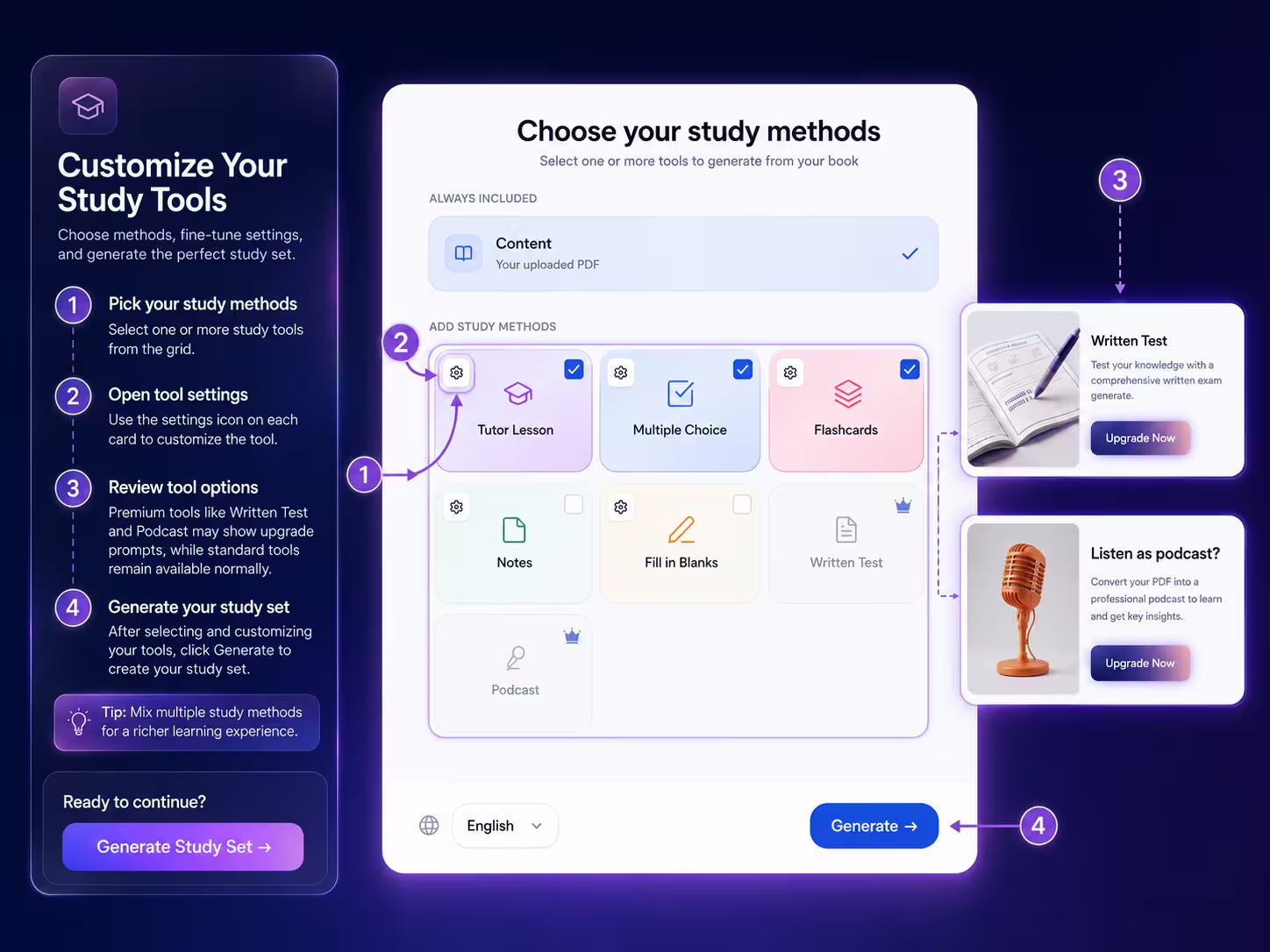
Upload the material you will be tested on
Lecture slides, a textbook chapter, your own notes. PDF, DOCX, and EPUB all work as long as the file has real text; scanned or image-only PDFs are not accepted. Garbage in, garbage out applies: one focused chapter beats a 400-page dump.
Generate the active formats first: quiz and flashcards
These are your retrieval-practice engines. Take the quiz cold before you re-read anything; the wrong answers are a map of exactly what to study (our AI quiz generator guide covers pretesting, feedback and auditing the questions). Keep the flashcard deck for short daily reps; our PDF-to-flashcards guide covers deck size, auditing the AI's cards, and the review schedule.
Generate the audio: podcast or read-aloud
Turn the same chapter into an AI podcast or listen to the full document with a natural voice. This is not a replacement for testing yourself; it converts commutes, gym sessions, and chores into extra exposures you would not otherwise get.
Use the tutor for what you got wrong, not instead of trying
When a quiz question stumps you, ask the AI tutor to explain the concept step by step. This mirrors the guardrailed setup that produced the 127% practice gain in the PNAS trial: explanation on demand, answers earned.
Finish with a practice exam under real conditions
A generated practice exam, taken closed-book and timed, is the closest simulation of the real thing. It also tells you whether your practice gains are real learning or AI-assisted illusion, which is exactly the gap the Wharton study exposed.
Every step of this system runs inside ReadLoudly Study Hub, but the sequence itself is tool-agnostic. Whatever you use, insist on the two design properties the evidence rewards: generation from your own documents, and formats that make you retrieve rather than recognize.
Match Each AI Output to a Proven Study Technique
Each AI study format earns its place only if it maps to a technique with real evidence behind it. Here is the honest mapping, including what each format is bad at.
| AI output | Technique it automates | Evidence strength | Weak spot |
|---|---|---|---|
| AI quiz | Retrieval practice (testing effect) | Strongest: g = 0.61 meta-analytic effect | Useless if you peek at answers first |
| Flashcards | Spaced repetition + retrieval | Strong: spacing wins at every interval tested | Weak for essay-style understanding |
| Audio podcast | Extra exposures in non-reading time | Good: listening comprehension matches reading | Passive if it is your only format |
| AI tutor | Guided explanation and feedback | Strong when scaffolded: 2x learning in Harvard RCT | Harmful when it hands over answers |
| Smart notes | Organization and overview | Modest: summaries aid orientation, not recall | Reading them feels like studying; it is not |
| Practice exam | Test simulation under exam conditions | Strong: transfer-appropriate practice | Only honest if taken closed-book |
A practical rule of thumb: spend roughly 70% of your AI study time in the formats that force retrieval (quiz, flashcards, practice exam) and 30% in the formats that build exposure and understanding (audio, tutor, notes). Most students run that ratio in reverse: in the Digital Education Council's global survey of 3,839 students across 16 countries, the top AI uses were information search (69%), grammar checking (42%), and summarizing (33%), and structured self-testing does not appear among them (DEC Global AI Student Survey, 2024).
Studying With Your Ears: The Audio-First Advantage
The most underused AI study capability in 2026 is audio, and it wins on a simple observation: the limiting factor for most students is not intelligence but usable hours. You cannot read on a crowded bus, at the gym, or while making dinner. You can listen in all three.
The evidence supports treating listening as real studying, not a lesser substitute. The Rogowsky comprehension study cited above found no significant difference between reading and listening for adult nonfiction, immediately or two weeks later. For students with dyslexia or ADHD, audio is often better than parity: it removes the decoding bottleneck entirely, which is why US schools grant text-to-speech as a formal reading accommodation in 504 plans and IEPs. Our guide on how students with dyslexia and ADHD use AI voice covers that side in depth.
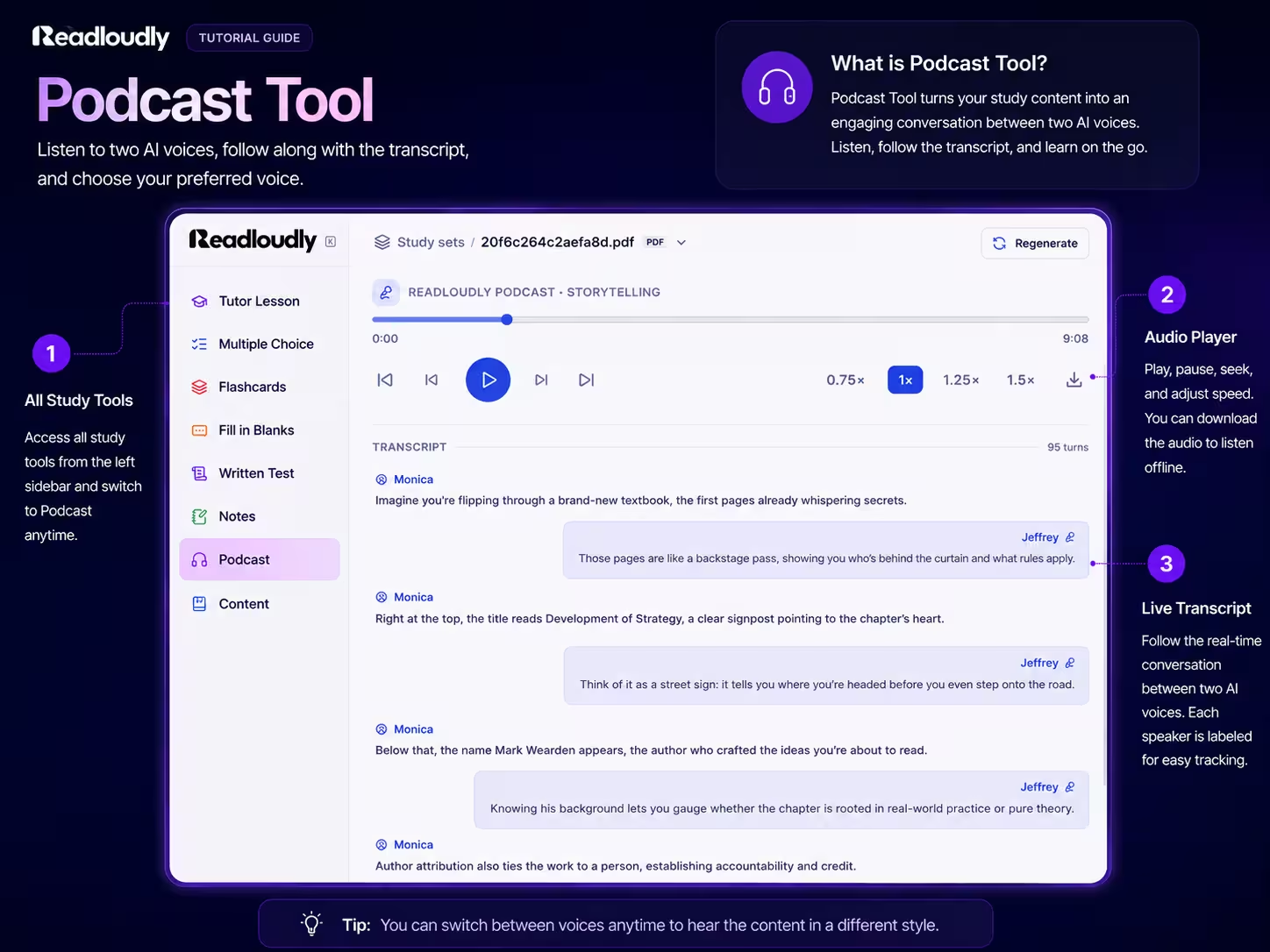
An audio-first study block looks like this: convert the week's chapter with a PDF-to-audio reader or generate the podcast version, listen during dead time at 1.25x to 1.5x speed, then do a five-minute flashcard rep when you sit down. The listening builds familiarity; the retrieval locks it in. Students who moved from highlighter-based studying to this loop describe the shift in our piece on replacing highlighters with AI audio.
Two honest caveats. Speed: push playback speed gradually; comprehension research is on natural-speed listening, so treat 2x as a review speed for material you already know, not a first pass. And passive listening alone will not pass your exam. Audio earns its place as the exposure layer of a system whose core is still retrieval.
A Realistic Week of Studying With AI
Here is what the full system looks like for one course, in about 4.5 focused hours across a week, most of it in time you were not using anyway.
One course, one week
- Monday (10 min): upload the week's lecture slides and chapter; generate quiz, flashcards, and podcast. Take the quiz cold and note what you missed.
- Tuesday to Thursday (20 min/day of dead time): podcast or read-aloud during the commute or gym. One five-minute flashcard rep each evening: that is your spacing engine.
- Friday (25 min): retake the quiz. For anything still wrong, work it through with the AI tutor, explanation first, then try a variation yourself.
- Weekend (45 min, exam weeks): generate a practice exam across all covered chapters. Closed book, timed, phone in another room. Score it, and let the wrong answers set next week's flashcard priorities.
The structure holds under pressure, too. The night before an exam, the same tools reshuffle into a triage sequence: quiz to find the gaps, tutor to patch the worst ones, audio recap while you pack your bag. We wrote that exact protocol up in the last-minute study guide, but be clear about what it is: damage control. The spacing research is unambiguous that four short sessions across a week beat one long night, every time.
5 Mistakes That Make AI Studying Worse Than No AI
Each of these mistakes shows up directly in the 2025-2026 research, and each has a specific fix.
Letting AI answer your practice problems
The 17% exam-score drop in the PNAS trial came from exactly this. Practice felt great; the exam told the truth. Fix: use AI for hints and explanations, and write your answer before you ever see the AI's.
Trusting AI citations and facts without checking
A 2025 test across eight chatbots found 39.8% of requested academic references were fabricated (arXiv:2505.18059). Fix: generate study material from your own uploaded documents, where every claim traces to a page, and verify anything a general chatbot asserts from memory.
Studying only in passive formats
Summaries, notes, and audio on their own recreate re-reading, the technique retrieval practice beats by g = 0.61. Fix: every passive session ends with a quiz or flashcard rep, even a two-minute one.
Compressing everything into the night before
AI makes cramming faster, not effective. The spacing literature (317 experiments) shows distributed practice wins at every retention interval. Fix: the ten-minute Monday upload ritual, so spacing happens by default.
Using a general chatbot for everything
ChatGPT is where 53% of student AI use happens (RAND), but a blank chat box has no memory of your syllabus, no spaced schedule, and no exam simulation. Fix: use chatbots for open questions, and a document-grounded study system for the course itself.
Notice the pattern across all five: every mistake replaces a moment of effortful thinking with a moment of comfortable consumption. The fixes all restore the effort where it counts and automate everything else.
Is Studying With AI Cheating?
Using AI to generate study materials, explanations, quizzes, and audio from your own course content is study help, not cheating, under essentially every 2026 academic integrity policy. Submitting AI-written work as your own is. Nearly everything students actually worry about falls cleanly on one side of that line.
Students themselves draw the line in the same place. In Pew's February 2026 survey, 54% of US teens said using AI to research new topics is acceptable, while only 18% said the same about using it to write essays (Pew Research Center). The distinction is not squeamishness; it tracks exactly what the learning research says. AI that helps you understand and test yourself improves the outcomes exams measure. AI that produces your submissions removes the learning the submission was supposed to demonstrate, which is what both the PNAS exam data and the MIT recall data show.
Three practical rules keep you safely on the right side:
- Generate questions, not answers. A quiz built from your textbook is study material, the same as a friend quizzing you. Nobody has ever been referred to an integrity board for testing themselves.
- Check your syllabus, not the vibes. Policies vary by course, and many instructors now state explicitly which AI uses are permitted. When a policy is silent, asking costs one email; guessing can cost a semester.
- Keep the thinking traceable to you. If you could explain and reproduce the work with the AI switched off, you learned it. That standard holds up under any integrity policy, and, more importantly, it holds up on the exam.
There is one group for whom this question has a sharper edge: students with documented reading disabilities, for whom text-to-speech and AI study formats are often formal accommodations rather than optional aids. If that is you, our guide to AI audio in the classroom for students with learning disabilities covers how these tools fit into official support plans.
What Studying With AI Should Cost in 2026
A complete AI study system should cost you $5 a month or less in 2026: document upload, quizzes, flashcards, podcasts, tutor, and practice exams included. You can assemble a workable free version for $0. Prices above that are paying for brand, not function.
| Approach | Monthly cost | What you get | What you give up |
|---|---|---|---|
| Free stack (free tiers combined) | $0 | Real studying on a budget; ReadLoudly's free tier has no daily listening cap | Generation limits, standard voices, juggling tools |
| ReadLoudly Core (Study Hub included) | $5 | All six study formats, 1,200+ voices, OCR, offline audio, one system | Honestly, not much at this price |
| Typical AI study apps (Quizlet Plus, Studley.ai, Speechify) | $8–$15 each | Usually one strong format per app | Stacking two or three subscriptions to cover one system |
We publish the detailed math elsewhere, including a line-by-line comparison against Studley.ai (where we concede its YouTube-to-study feature is genuinely better) and a $0 free AI study stack for students who should not be paying anything yet. The honest guidance: start free, and pay only when you hit a real limit, not because a landing page made you anxious. When you do hit that limit, here is exactly what Core unlocks.
ReadLoudly tools: Study Hub · Text to Speech · PDF Reader · Ebook Reader
Getting Started Today
Your first action takes five minutes: upload one document from a course you are actually taking, generate a quiz, and take it cold. The score does not matter. What matters is that you have just replaced "I should study more" with a measurable baseline and a generated deck of exactly what you got wrong.
From there, add one habit per week. Week one, the Monday upload ritual. Week two, audio during one commute or workout, using the textbook audio reader workflow if your course is textbook-heavy. Week three, the closed-book practice exam. Three weeks in, you will be running a study system backed by the strongest evidence in learning science, largely on time you used to lose.
The students pulling ahead in 2026 are not the ones using AI the most. They are the ones using it to do more retrieval, more spacing, and more listening, while everyone else uses it to do less thinking. Which side of the 17% you land on is a choice you make at upload time.
Turn your next chapter into a study set
Upload one PDF, DOCX, or EPUB and get the quiz, flashcards, podcast, tutor, notes, and practice exam in about a minute. Free to start, no credit card, and the paid plan is $5, not $15.
Open Study Hub Free